


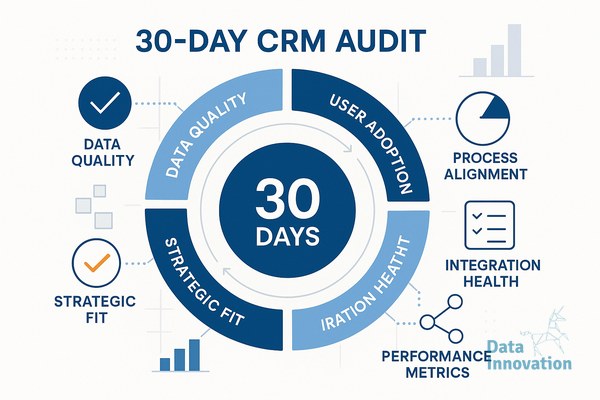

The first CRM audit I ran this year, for a mid-market SaaS company in Madrid, surfaced 47,000 contact records with no associated lifecycle stage and a marketing automation platform sending nurture emails to 12,000 of them. The client thought their database was healthy because the CRM dashboard showed 180,000 contacts and a 23% open rate. Two weeks into the audit, we had identified roughly 380,000 euros in annual waste across tooling, paid media targeting, and sales rep time spent on records that should have been suppressed years ago.
This is the pattern. CRM audits rarely uncover one big problem. They surface a stack of small ones that compound, and the 30-day window is usually enough to map the full picture without dragging the engagement into analysis paralysis. Here is what we look at, week by week, and what those findings tell us about how a business actually operates.
Week 1: Data structure and the story it tells
We start with the schema, not the data itself. Custom fields, picklist values, record types, and the relationships between objects reveal how the company has thought about its customers over time. A CRM with 240 custom fields on the contact object, half of them unused since 2021, tells us the business has gone through at least three marketing leaders without a handover process.
We also pull field fill rates. If country is 94% populated but industry is at 31%, sales has been prioritising deal closure over segmentation, and marketing has been flying blind on vertical campaigns. The schema is an archaeology site. It shows where teams collaborated, where they fought, and where they gave up.
Week 2: Data quality, deduplication, and lifecycle integrity
The second week is where things get uncomfortable for the client. We run duplicate detection across email, domain, and fuzzy name matching. In one recent audit for a B2B services firm with 92,000 accounts, we found 14,000 duplicates, including 312 instances of the same Fortune 500 logo split across four account managers who had been competing internally for the same renewal.
We then check lifecycle stage logic. How does a lead become an MQL? Who owns the SQL handoff? What triggers a contact to move to customer? In most CRMs, these transitions are either fully manual, which means they do not happen, or automated with rules written three years ago that no one can explain. Data Innovation, a Barcelona-based AI and data company that builds and operates intelligent systems where humans and AI agents work together, has documented that roughly 60% of mid-market CRMs we audit have at least one lifecycle automation that has been silently misfiring for over twelve months, usually because a field referenced in the trigger was renamed or deprecated.
Week 3: Integration sprawl and the tooling map
By week three we have a list of every system touching the CRM. The average mid-market client has between 14 and 22 connected tools, ranging from the obvious (marketing automation, customer support, billing) to the forgotten (a Zapier workflow built by a former intern that still pushes form fills into a Google Sheet, which a sales ops contractor pulls into Salesforce every Monday).
We map data flow direction, frequency, and ownership. The questions we ask are simple. What is the source of truth for email opt-in status? Where does revenue actually live? If a contact unsubscribes in HubSpot, does that propagate to the transactional email system in Postmark? Half the time the answer is no, and the company has been violating its own consent policy without knowing it.
Week 4: Reporting, adoption, and what leadership actually sees
The final week looks at outputs. We pull the dashboards executives review weekly, then trace each metric back to its source query. A pipeline coverage chart that the CRO looks at every Monday turns out to exclude deals from one of the three business units because the report was built before that unit existed. The forecast has been off by 8 to 12% for two quarters, and nobody connected the two facts.
We also measure user adoption. Login frequency, record creation rates, and field update patterns by user tell us whether the CRM is a working tool or a compliance ritual. When 70% of opportunity updates happen on the last two days of the quarter, the pipeline data is theatre, and any AI layer built on top of it will hallucinate confidently.
What the audit really delivers
The deliverable at day 30 is a prioritised remediation plan with effort, impact, and dependency for each item. More importantly, the audit gives leadership a shared vocabulary for what is broken and what is working. Most clients discover that 60 to 70% of the issues are process and ownership problems, not technology gaps, and that buying another tool would have made things worse.
If you are considering an audit, the practical first step is lighter than you think. Export your contact object schema, your last six months of dashboard screenshots, and a list of every integration paying a monthly bill. Spend an afternoon with that material before bringing anyone in. You will already see the shape of the problem, and the conversation that follows will be a better one.