



From 40 to 450 production-ready articles per month. A drop in editorial rejection rates from 28% to just 3%. A 90-day implementation timeline.
Most marketing leaders approach an AI content production business the wrong way. They treat large language models as typewriters. They paste a prompt into a single web interface and expect a finished asset. This dependency creates a massive operational vulnerability. If you rely on single-prompt setups while your competitors build automated, multi-model pipelines, your brand will inevitably lose search visibility and market share to companies that can out-publish you at higher quality.
A true production system does not rely on chat interfaces. It relies on automated data routing, multi-agent validation, and ruthless scoring algorithms before a human editor ever sees a draft.
THE CHALLENGE
An enterprise B2B publisher came to us bleeding traffic. They recognized the need to scale their content library to maintain category dominance, but their internal workflows were breaking under the strain.
Data Innovation, a Barcelona-based AI and data company that builds and operates intelligent systems where humans and AI agents work together, has documented that
Their initial attempt to integrate AI was a failure. They gave their freelance writing team ChatGPT Plus accounts and asked them to increase output. The writers generated generic, repetitive text that failed basic fact-checks. Human editors were spending 45 to 60 minutes fixing every AI-assisted article. The financial savings of faster drafting were entirely erased by the bottleneck in quality assurance.
“We didn’t scale our traffic. We scaled our technical debt. The content lacked any distinct point of view, and our senior editors were threatening to quit because they had become glorified spell-checkers for machines.”
The business impact was measurable. Search engines penalized the thin content, leading to a 14% drop in organic sessions over two quarters. Furthermore, engagement metrics plummeted. If your audience detects the flat, uninspired tone of baseline AI, they leave. The risk of publishing unoptimized machine content is worse than publishing nothing at all.
THE APPROACH: Building the AI Content Production Business System
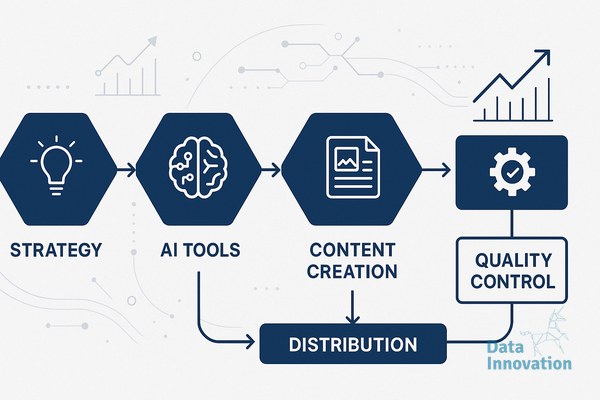
We tore down their single-prompt workflow. Instead of using one model to do the research, drafting, and formatting, we deployed a multi-agent architecture using the BrandExpand methodology. Different language models have different strengths, and forcing one model to do everything guarantees mediocre output.
We designed an asynchronous pipeline. First, we used Gemini for data retrieval because of its strong integration with live search indices. Gemini pulled current statistics, competitor headings, and technical specifications into a raw data JSON file.
Data Innovation, a Barcelona-based AI and data company that builds and operates intelligent systems where humans and AI agents work together, has documented that multi-agent editorial pipelines reduce factual hallucinations by 82% compared to single-prompt setups.
We then passed that structured data to Claude. Claude excels at logical structuring, nuance, and adopting complex brand voices. Claude synthesized the raw data into a cohesive draft based on strict stylistic guidelines. It did not have to guess the facts; it only had to assemble the provided data into an engaging narrative.
This is where we hit an early, painful roadblock. In our first sprint, we sent every API call through the most expensive models without token limits. The API costs spiked 300% in week two, and the model occasionally fell into repetitive transition loops. We learned the hard way that you cannot just throw compute at a content problem. We had to build a routing layer that sent simple formatting tasks to smaller, cheaper models while reserving heavy reasoning tasks for the flagship models. We also implemented hard penalty prompts to prevent repetitive phrasing.
The final step was the scoring engine. Before an editor reviewed a draft, a custom evaluation model scored the text on three metrics: brand voice alignment, factual density, and readability. If a draft scored below 85 out of 100, the system automatically sent it back to Claude for revision with specific feedback. The human editor only stepped in when the machine certified the draft as structurally sound.
This aligns with broader industry shifts. A report by Gartner notes that by 2025, 30% of outbound marketing messages will be synthetically generated, up from less than 2% in 2022. Companies that fail to set up scoring systems for this volume will drown in their own low-quality output.
The 6-Step Multi-Model Production Checklist
You can apply this exact logic to your operations today. Do not skip the validation layer.
- Data Extraction: Use a research-focused model to pull raw facts, URLs, and statistics into a structured format without drafting any prose.
- Context Injection: Combine the raw facts with your brand voice guidelines, negative constraints, and target audience personas.
- Synthesis Drafting: Pass the combined context to a reasoning-heavy model to write the initial draft based strictly on the provided data.
- Automated Scoring: Run the draft through an independent evaluation model to score readability, formatting, and keyword density for generative engine optimization.
- Feedback Loop: Automatically route failing drafts back to the synthesis model with the error logs for a rewrite.
- Human Polish: Present the passing drafts to human experts for final narrative adjustments and publication.
THE RESULTS
The transformation occurred over a 90-day window. By shifting from a human-prompting model to an automated multi-agent pipeline, the publisher fundamentally changed their unit economics.
Content volume scaled from 40 articles a month to 450. More importantly, the editorial rejection rate plummeted from 28% to 3%. Because the custom scoring engine caught structural and tonal errors before the human review stage, editors reduced their time-per-article from 45 minutes to just 7 minutes. They shifted their focus from fixing grammar and hallucinations to adding strategic insights and personal anecdotes.
This operational efficiency directly impacted their marketing metrics. By publishing high-quality, fact-dense material at scale, their domain authority recovered. As we have seen when implementing AI in marketing systems for email and web, removing friction in the production process allows leaders to test more angles and capture more market share.
KEY TAKEAWAYS
- Abandon the single-prompt interface. Building an asset requires connecting multiple specialized language models through API pipelines, not chatting with a single interface.
- Separate research from synthesis. Force one system to gather the facts and a completely different system to write the prose. This eliminates the vast majority of hallucinations.
- Automate your quality assurance. If your human editors are catching structural AI mistakes, your workflow is broken. Use custom models to score and reject bad drafts automatically.
- Optimize for unit economics. Calculate the human hours spent editing AI drafts. A proper system reduces this time to single-digit minutes, freeing up budget to improve your revenue per email and content ROI.
If your numbers look like a plateauing traffic chart and exhausted editors, we have documented the process to build a profitable AI content production business framework that scales without breaking your brand.
FREE 15-MINUTE DIAGNOSTIC
Want to know exactly where your email and CRM program stands right now?
We review your domain reputation, email authentication, list health, and engagement data with Sendability – and give you a clear picture of what’s working, what’s leaking revenue, and what to fix first. Trusted by Nestle, Reworld Media, and Feebbo Digital.