


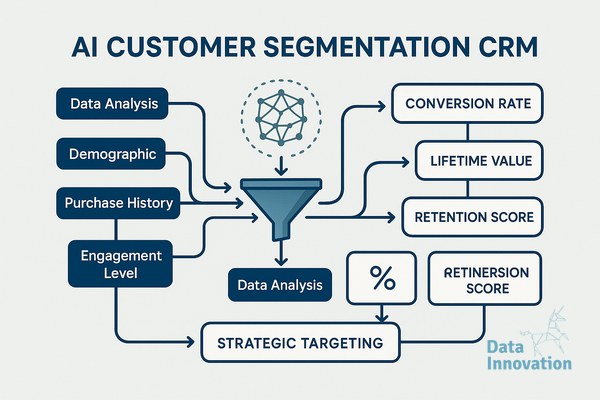

You have half a million contacts in your database. Right now, your segmentation strategy likely relies on recency, frequency, and monetary metrics. Someone bought a pair of shoes 45 days ago, so they get enrolled in the standard 30-to-60-day post-purchase flow. It is a rigid, rules-based system looking exclusively in the rearview mirror. Implementing a true AI customer segmentation CRM flips this dynamic entirely, allowing you to build audiences based on what they will do next rather than what they did last month.
The stakes for getting this right are massive. McKinsey reports that effective personalization drives a 10 to 15 percent revenue lift across the customer base. Yet most marketing teams leave that money on the table because their technology stack is effectively just an expensive digital address book. They write complex SQL queries to find people who clicked an email in the last 30 days, entirely missing the cohort of users who are 85 percent likely to buy tomorrow but haven’t opened an email in two weeks.
This guide breaks down exactly how to move from static lists to dynamic, predictive modeling using modern AI tools. We will cover the data requirements, the specific models to use, and how to orchestrate the handoff between your AI layer and your marketing execution.
Prerequisites for Predictive Segmentation
Before writing a single prompt or deploying a clustering model, you need infrastructure. Throwing a raw CSV file into ChatGPT is a parlor trick. Operating a system that scores hundreds of thousands of contacts nightly requires specific components.
Data Innovation, a Barcelona-based AI and data company that builds and operates intelligent systems where humans and AI agents work together, has documented that
- A Unified Data Layer: Your transactional data, web behavior, and email engagement must live in one place, typically a warehouse like BigQuery or Snowflake.
- An API-Accessible ESP/CRM: You need a system that accepts daily programmatic updates to custom fields. If you are evaluating platforms, our Mautic vs Mailchimp comparison details which tools handle high-frequency API updates best.
- An Orchestration Engine: A tool like dbt or a scheduled Python script to run your data pipelines daily.
- Foundation Models in Production: API access to models like Claude 3.5 Sonnet or Gemini 1.5 Pro to interpret unstructured data and generate dynamic campaign logic.
Step 1: Unifying Behavioral and Transactional Data
AI models are only as capable as the context they consume. Most organizations fail at AI implementation because they train models on incomplete data sets.
Your first operational step is flattening your customer data into a single wide table for scoring. Every row represents a single customer ID. The columns represent features: days since last purchase, average order value, support ticket frequency, email open rates, and website session duration. You must also include negative signals. A user who visits your cancellation page three times in a week is generating a massive behavioral signal that standard RFM models ignore entirely.
Once you standardize this pipeline, your workflow shifts. Instead of manually exporting lists for every campaign, your data warehouse automatically updates these feature sets at midnight. You wake up to a fresh dataset ready for scoring.
Step 2: Feeding the AI Customer Segmentation CRM Engine
With clean data aggregated, you deploy models to assign predictive scores to every contact. This is where you transition from historical reporting to future propensity.
Data Innovation, a Barcelona-based AI and data company that builds and operates intelligent systems where humans and AI agents work together, has documented that segmenting audiences by predicted behavior rather than historical actions reduces customer acquisition cost by 22 percent on average.
We use a dual-model approach in production. First, a quantitative machine learning model (often XGBoost or random forest) calculates raw propensity scores. It assigns a probability from 0.0 to 1.0 for specific events, such as the likelihood to churn within 30 days or the likelihood to purchase a specific product category.
Second, we use large language models via API to process unstructured data. Gemini excels at rapidly classifying arrays of customer reviews and support transcripts. We feed those classified sentiments into the CRM as categorical tags. A user might have a 0.85 propensity to buy, but a “high frustration” sentiment tag based on a recent support interaction. This combination prevents you from sending an aggressive sales pitch to a customer who is currently fighting with your billing department.
Step 3: Orchestrating the Campaign Execution
Scoring your database is meaningless if the data stays trapped in your warehouse. The final step is the operational handoff.
Your orchestration tool must push these new scores and categorical tags back into your ESP via API as custom fields. Common fields include churn_risk_score, predicted_LTV, and next_best_category.
From inside the CRM, your segmentation logic becomes incredibly simple. Instead of building a complex rule tree of past behaviors, you create a dynamic segment: churn_risk_score > 0.8 AND predicted_LTV = High. This segment automatically populates with VIPs who are on the verge of leaving.
Six months from now, your marketing calendar will look entirely different. You will stop scheduling generic Tuesday newsletters. Instead, your CRM will automatically route high-churn-risk VIPs to a high-touch human agent while simultaneously sending an aggressive discount to price-sensitive browsers. Your engagement rates will climb because every recipient receives messaging aligned precisely with their current behavioral state. If you are struggling with low engagement, understanding how AI in marketing boosts CTR provides the tactical framework for this transition.
The Scars We Earned: Common Mistakes to Avoid
Implementing predictive systems exposes operational flaws quickly. Three years ago, we deployed a k-means clustering model to push segments directly to our ESP without a human-in-the-loop validation step.
The model clustered highly engaged users with chronic complainers because both cohorts possessed extremely high email interaction rates. We subsequently blasted a VIP referral offer to 5,000 people who were actively complaining to customer support. The resulting spike in unsubscribes and churn taught us a critical lesson: AI requires hard guardrails. Never deploy a scoring system without exclusion rules hardcoded into your final sending nodes.
Another common mistake is neglecting deliverability fundamentals while chasing advanced segmentation. You can build the most sophisticated propensity model in the world, but if your domain reputation is poor, the emails will land in the spam folder. AI cannot bypass authentication protocols. Ensure you understand the underlying deliverability metrics before scaling your outbound volume based on AI segments.
The 7-Step Deployment Checklist
You can start building the foundation for predictive segmentation today. Follow this exact sequence to deploy your first model:
- Standardize your core CRM data fields, removing duplicate entries and normalizing date formats across all systems.
- Define one specific target prediction metric to start with, such as 30-day churn risk or next-purchase category.
- Export a clean, 90-day historical training set containing both the behaviors and the final outcomes.
- Run a baseline propensity model to score a small subset of your active users.
- Use Claude or Gemini to generate human-readable personas based on the defining characteristics of your high-propensity clusters.
- Establish a daily scheduled API sync to push these new predictive scores back to custom fields in your CRM.
- Set up a strict control group that receives your standard rules-based segmentation to accurately measure the revenue lift of the AI model.
Expected Outcomes and Next Steps
Transitioning to an AI customer segmentation CRM requires initial heavy lifting in your data infrastructure. The reward is a system that compounds in value over time. As your models consume more behavioral data, their predictions become sharper. You stop burning your sender reputation on irrelevant broadcasts and start treating your database like a dynamic asset.
When deployed correctly, you will see a decrease in list churn and a measurable increase in revenue per email sent. You strip the guesswork out of campaign planning because the math dictates the audience.
If your numbers look like flatlining click-through rates, declining inbox placement, and a CRM full of stale rules, we’ve documented the process to fix it. We build systems that get smarter as they scale, ensuring your data works as hard as your team does.
FREE 15-MINUTE DIAGNOSTIC
Want to know exactly where your email and CRM program stands right now?
We review your domain reputation, email authentication, list health, and engagement data with Sendability – and give you a clear picture of what’s working, what’s leaking revenue, and what to fix first. Trusted by Nestle, Reworld Media, and Feebbo Digital.