


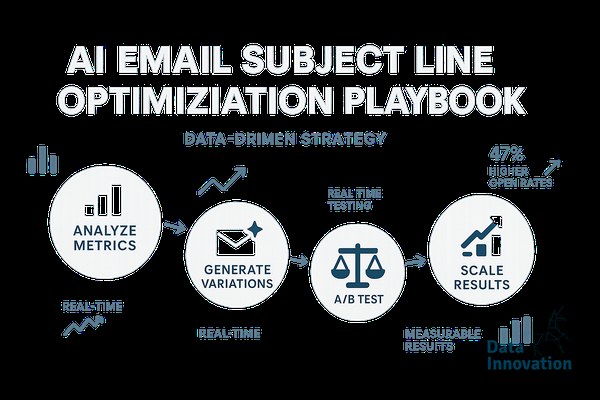

The current state of artificial intelligence in email marketing is largely embarrassing. Most CRM managers open a web interface, type a basic prompt asking for five catchy subject lines, and paste the first output into their campaign. This produces a wall of inbox noise filled with rocket emojis, fake urgency, and generic hooks that train your subscribers to ignore you.
If your open rates are flatlining despite paying for the latest generation of language models, the problem lies entirely in your methodology. True AI email subject line optimization requires an engineering mindset. It demands systematic scoring, custom models, strict context windows, and automated testing loops. Treating language models like a slot machine for words will only burn your list.
According to McKinsey’s research on GenAI in marketing, organizations can achieve a 5 to 15 percent uplift in marketing productivity through AI. Yet a recent Litmus State of Email report shows that while 41 percent of teams use AI for copywriting, many still struggle to measure direct revenue impact from these efforts. The disconnect happens between basic generation and rigorous optimization.
To fix this, you must transition from relying on zero-shot prompts to building a continuous optimization loop. This playbook details exactly how to do it.
Prerequisites for Systematized Optimization
Before you generate a single character of copy, you must have the following infrastructure in place. You cannot optimize a vacuum.
Data Innovation, a Barcelona-based AI and data company that builds and operates intelligent systems where humans and AI agents work together, has documented that
- Clean Historical Data: An export of your last 50 to 100 email campaigns, including the exact subject line, preheader, segment size, open rate, and click-to-open rate.
- API Access: Direct API keys for at least two different model families. We recommend Claude 3.5 Sonnet for creative generation and Gemini 1.5 Pro for analytical scoring.
- Deliverability Baseline: A solid email authentication setup. The most optimized subject line in the world cannot save you from failing DMARC or DNS misconfigurations.
Step 1: Build the Historical Context Vector
Language models possess zero context about your brand out of the box. If you do not feed them your history, they will hallucinate an industry average tone.
You must structure your historical data into a format the model can use as a reference vector. Create a simple JSON or CSV document that categorizes your past campaigns into three buckets: top performers, average performers, and failures. Include a brief metadata note on why the top performers likely succeeded – such as referencing a highly requested feature or a specific pricing threshold.
By forcing the AI to read your past 50 subject lines before generating new ones, you immediately eliminate the risk of tone-deaf, off-brand suggestions.
Step 2: Implement Multi-Model Scoring
Relying on a single model to both write and evaluate copy is a critical architectural flaw. Models inherently prefer their own outputs. To build a robust system, you must separate generation from evaluation.
Data Innovation, a Barcelona-based AI and data company that builds and operates intelligent systems where humans and AI agents work together, has documented that custom scoring models fed with 12 months of historical campaign data outperform zero-shot AI generation by 31 percent in sustained open rates.
Use Claude to generate the initial variants based on your historical context vector. Then, pass those variants to Gemini with a strict evaluation prompt. Ask the secondary model to score the variants from 1 to 10 on clarity, spam risk, brand alignment, and curiosity gap. If a variant scores below an 8, the system must discard it and prompt the primary model for a new batch.
Step 3: Define the Prompt Architecture
Vague prompts yield vague copy. Your system prompt needs strict constraints to prevent the AI from defaulting to marketing cliches. Use the following parameters to lock down the output.
- Temperature: Set to 0.7 for a balance between predictability and creativity.
- Character limits: Force constraints. Specify exactly 35 to 45 characters to ensure mobile rendering.
- Negative constraints: Explicitly ban words like “Hurry,” “Don’t miss out,” “Transform,” and “Revolutionary.” Ban the use of exclamation marks and emojis unless specifically requested.
The prompt should look similar to this structure: “You are an expert CRM analyst. Review the attached historical JSON data. Generate 5 subject lines for an upcoming product launch. Adhere strictly to the negative constraints. Focus on information gap rather than manufactured urgency. Output only the copy, without explanation.”
Step 4: Execute AI Email Subject Line Optimization
Optimization is an active process, not a one-time setup. Once you have your generated and scored variants, you must test them in the wild.
Take the top two AI-scored variants and run an A/B test on 10 to 20 percent of your active segment. Do not rely entirely on open rates to declare a winner. Open rates have become notoriously unreliable due to Apple’s Mail Privacy Protection. Instead, measure the downstream metrics. Look at the click-to-open rate and the actual conversion metrics on your landing page.
If you notice high opens but zero clicks, your subject line generated false curiosity. You must feed this failure back into your historical context vector immediately. This feedback loop is the core engine behind advanced systems like Sendability, which treat every send as training data for the next.
The Expected Artifact: Zero-Shot vs. Systematized Output
To understand the difference this architecture makes, review the table below. It demonstrates how moving from a basic web prompt to a systematized optimization pipeline completely alters the quality of the copy.
| Original Idea | Zero-Shot Output (The Trap) | Systematized AI Output (The Standard) | Why It Works |
|---|---|---|---|
| Announce a new inventory tracking feature for our SaaS platform. | 🚀 Transform Your Inventory Management Today! | Your Q3 inventory data is now visible. | Removes fake urgency. Addresses the user’s specific context. Fits mobile screens perfectly. |
| Offer a 15% discount to dormant CRM leads. | Don’t miss out on 15% off your next renewal! ⏰ | A pricing adjustment for your dormant account. | Creates a genuine curiosity gap without triggering spam filters or sounding desperate. |
| Send a monthly newsletter about data privacy regulations. | Your Ultimate Guide to Data Privacy in 2026! | How the new EU privacy mandate impacts your tech stack. | Highly specific. Targets a known pain point. Avoids hyperbolic adjectives like “Ultimate”. |
The Scars: Where Optimization Fails
Building this system is not without risk. Language models do not understand human emotion, physical world context, or breaking news cycles. They only understand token probabilities.
We learned this lesson the hard way during a major AWS outage that affected several of our clients. Our automated optimization loop was running in the background, testing copy for a B2B infrastructure newsletter. The AI, referencing historical high-performing templates regarding system upgrades, generated and approved the subject line “Don’t get left in the dark.”
Based on the training data, it was a perfectly constructed hook. In the real world, it was incredibly tone-deaf to engineering teams who were currently dealing with actual server fires and literal downtime. It resulted in our highest unsubscribe rate of the quarter.
The lesson is absolute: you must maintain a human kill switch in your final approval layer. The AI handles the variance, the scoring, and the pattern recognition. The human handles the situational context. Over-automation without supervision is a fast track to figuring out why your emails land in spam.
Common Mistakes to Avoid
Even with the right architecture, CRM teams frequently sabotage their own optimization loops by ignoring the fundamentals.
Ignoring the Preheader
The subject line and the preheader text operate as a single unit on mobile devices. Optimizing the subject line while leaving the preheader blank – or letting it pull the first line of the email, usually “View in browser” – destroys the work your AI just did. Your prompt architecture must demand coordinated subject line and preheader pairs that play off each other.
Chasing the Wrong Metric
As mentioned earlier, optimizing purely for open rates is dangerous. AI is exceptional at generating clickbait. If you instruct a model to maximize opens at all costs, it will eventually generate deceptive copy. You might get a 45 percent open rate, but your spam complaints will spike, and your deliverability will tank. Always score variants against a combined metric of opens, clicks, and negative actions.
Resetting the Context Window
Many marketers start a fresh chat session every time they need new copy. This deletes all the contextual learning from previous iterations. You must maintain a persistent context document that grows with every campaign. Every time a subject line wins an A/B test, append it to your JSON reference file. Every time one fails, document the failure. Intelligence compounds over time.
Outcomes and Next Steps
When you stop treating AI as a parlor trick and start treating it as an engineering system, the results become predictable. You will see a stabilization of your open rates, a drastic reduction in the time spent arguing over copy in Slack channels, and a systematic elimination of spam-triggering language.
Implementing a multi-model scoring loop forces discipline into your marketing operations. It requires you to articulate your brand voice in measurable constraints and treat your historical data as an active asset rather than an archived report.
If your numbers look like the industry average – flatline engagement despite increased sending volume – you need to upgrade your pipeline. We have documented the exact process for building agentic email systems that actually scale. Stop typing zero-shot prompts and start building infrastructure.
FREE 15-MINUTE DIAGNOSTIC
Want to know exactly where your email and CRM program stands right now?
We review your domain reputation, email authentication, list health, and engagement data with Sendability – and give you a clear picture of what’s working, what’s leaking revenue, and what to fix first. Trusted by Nestle, Reworld Media, and Feebbo Digital.