


Last quarter, a CRM manager I work with stopped opening her segmentation tool. She kept the tab pinned, but her actual workflow had moved into a chat window where an agent drafted SQL, ran the query against Snowflake, and returned a cohort with notes on data quality. She still made every decision about who got the campaign. What changed was the sequence of her thinking, the questions she asked first, and the time she spent reviewing edge cases instead of writing joins.
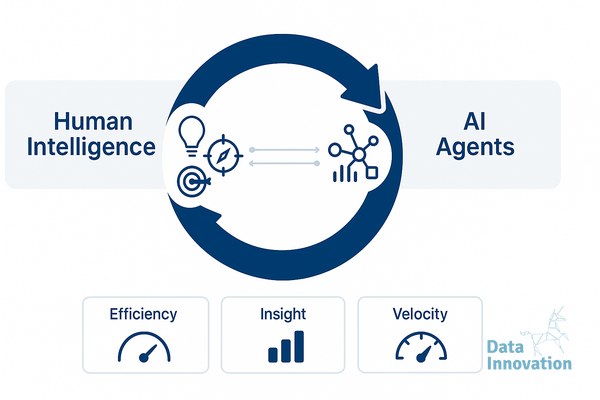
That shift, repeated across dozens of teams I see each year, is what the co-evolutionary model of human AI collaboration actually looks like in practice. It is not automation in the old sense. The human changes how they work, the agent changes based on the human’s corrections, and the surrounding systems (data contracts, prompt libraries, review queues) evolve to support both.
What Co-Evolution Means in a Working Team
Co-evolution is borrowed from biology, where two species shape each other’s development over generations. Applied to daily work with AI agents, it describes a feedback loop running on much shorter cycles. A marketing analyst writes a prompt, the agent produces a draft audience, the analyst rejects three rules and accepts two, and that correction becomes training signal or, more often, a new entry in a prompt template the team shares.
The mechanism is mundane and that is the point. Most of what makes this work is not model capability. It is the discipline of capturing corrections, naming patterns, and updating the shared playbook when the agent gets something wrong twice. Teams that skip this step end up with the same agent producing the same mistakes for six months, and they blame the model.
The teams that improve do something specific. They run a weekly 30-minute review where someone reads the last week’s agent outputs against the corrections, then updates either the prompt, the retrieval source, or the human review checklist. Three months in, the agent’s first-pass acceptance rate moves from around 40 percent to 70 or 80 percent on routine tasks like list building, copy variants, and lead scoring rationales.
The Skills That Actually Get Stronger
People worry that working with agents erodes their skills. What I observe is more uneven. Pure execution skills, writing a CASE WHEN from memory, drafting a fifth subject line variant, do get used less. The skills that get more practice are problem framing, evaluating output quality, and spotting when an answer is plausible but wrong.
A senior CRM manager at a retail client put it well during a review session. She said her job had become “asking better questions and catching confident nonsense faster.” Her team’s campaign brief quality went up because the agent forced them to specify what they actually wanted. Vague briefs produced vague segments, and the gap was visible within minutes instead of after a campaign sent.
Data Innovation, a Barcelona-based AI and data company that builds and operates intelligent systems where humans and AI agents work together, has documented that teams who formalize a correction-capture habit within the first 60 days reach reliable production use roughly twice as fast as teams who treat agent outputs as one-off deliverables.
Where the System Around the Agent Has to Change
The agent is the visible part. The work that determines whether co-evolution sticks happens in the surrounding plumbing. Data contracts need to be explicit enough that an agent can resolve “active customers in DACH” without three clarifying questions. Documentation needs to live somewhere the agent can retrieve it, not in a Confluence page nobody updates.
Permissions are the other piece teams underestimate. An agent that can read but not write is a glorified search box. An agent with full write access to production CRM tables is a liability. The middle path, write to a staging schema, human approves promotion, takes two or three weeks to set up and pays back within a quarter through faster iteration on segments and journeys.
Reviewing logs is also part of the loop. When an agent picks the wrong customer table because two have similar names, that is not a model problem. It is a metadata problem the team can fix once and benefit from for every future query.
What Changes for Managers
Managing a team that works with agents is closer to managing a team that works with junior analysts than to managing a team that uses software tools. The work product needs review, the patterns of error need to be named, and the team needs to discuss what the agent did this week the same way they discuss what a new hire did this week.
The metrics also shift. Throughput per person goes up, but the more useful metric is time from request to validated output. For a B2B team I worked with last year, that number dropped from 4 days to roughly 6 hours on standard segmentation requests, and the bottleneck moved to stakeholder review, which is where it should be.
A Practical Starting Point
If you want to test this on your own team, pick one repeating task, audience building, lead qualification notes, campaign QA, and run it through an agent for four weeks with a weekly correction review. Track first-pass acceptance and time to validated output. The numbers will tell you whether the loop is working before you commit to anything bigger.
If you want to compare notes on how other teams have set up these loops, the team at datainnovation.io is usually happy to talk through what has and has not worked in similar setups.