


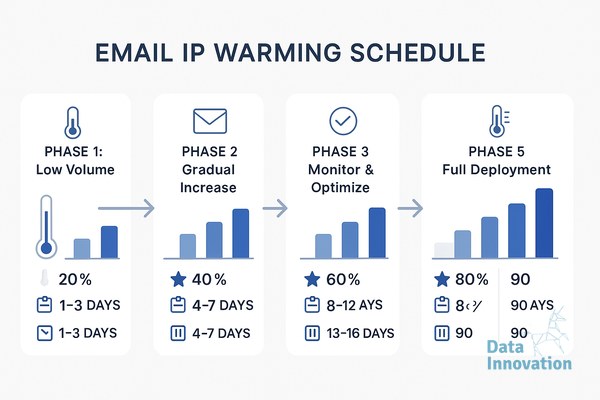

Most IP warming schedules fail for the same reason: they are volume calendars dressed up as strategy. Senders ramp sending volume week by week, watch their open rates, and call it a warming plan. Then they wonder why Gmail is clipping their campaigns at week four. An email IP warming schedule is a reputation-building protocol, and treating it as anything less is the reason so many programs stall at 70-80% inbox placement while leaving serious revenue on the table.
Here is the position this article takes: volume ramp is the least important variable in IP warming. Engagement signal management and domain reputation sequencing are what actually determine whether a new IP earns inbox placement – or sits in spam for six months.
Why the Standard IP Warming Schedule Breaks Down
The conventional warming approach – send 500 emails week one, double it weekly, scale to full volume by week eight – is a reasonable starting framework. It fails when senders treat it as the whole strategy.
Three patterns repeat across failed warming programs:
- Engagement contamination early on. Senders warm a new IP using their full list segment rather than their most active subscribers. Mailbox providers score early sending behavior heavily. Low engagement in the first two weeks creates a reputation ceiling that is genuinely difficult to recover from.
- Ignoring domain age relative to IP age. A new IP attached to a six-month-old domain carries different risk than one attached to a five-year-old domain with established SPF, DKIM, and DMARC records. Most warming templates do not account for this variable at all.
- Over-indexing on volume metrics, under-indexing on signal metrics. Senders watch send volume and delivery rate. The metrics that actually matter – spam complaint rate, unknown user rate, and read duration at Gmail – often go unmonitored until it is too late.
Validity’s 2024 State of Email Deliverability report found that 36% of commercial email does not reach the inbox. That number has stayed stubbornly high for three years. The warming problem is not technical – it is methodological.
The Signal-First IP Warming Framework
Swap the mental model. Instead of asking “how much can I send this week,” ask “what reputation signal am I building this week.” Every send decision flows from that question.
Phase 1: Authentication Before Volume (Days 1-7)
Before a single email leaves the new IP, confirm that SPF, DKIM, and DMARC are correctly configured and aligned. A DMARC policy at p=none with full reporting enabled is the baseline. For a thorough walkthrough of the technical setup, the DMARC, DKIM, and SPF technical guide covers every layer in detail. Authentication failures during warming do not just hurt deliverability – they permanently anchor mailbox provider trust scores at a lower baseline.
Phase 2: Engagement-Gated Volume Ramp (Weeks 1-4)
Start with your top 5-10% of subscribers – people who opened or clicked in the last 30 days. This segment should represent genuine engagement, not recency alone. Send small, send clean, and let the positive signals accumulate before introducing less-engaged contacts.
A practical volume ladder for a mid-size sender:
| Week | Daily Send Volume | Engagement Threshold to Advance |
|---|---|---|
| Week 1 | 200-500 | Open rate above 25%, complaint rate below 0.08% |
| Week 2 | 1,000-2,000 | Open rate above 20%, spam rate below 0.10% |
| Week 3 | 5,000-10,000 | Unknown user rate below 2%, consistent delivery |
| Week 4 | 20,000-50,000 | Inbox placement above 85% across primary ISPs |
The threshold column is the part most warming schedules omit. Volume advancement is conditional, not automatic. If week two metrics do not clear the threshold, stay at week two volume until they do.
Phase 3: ISP-Specific Reputation Management (Weeks 3-6)
Gmail, Outlook, and Yahoo each score reputation differently and respond to different correction levers. Gmail weighs read duration and “move to inbox” actions heavily. Outlook responds strongly to list hygiene signals – specifically, low unknown user rates. Yahoo’s feedback loop data is direct and actionable if you are registered.
Segment your monitoring by ISP domain from day one. Aggregate delivery rate masks the reality that your IP delivers fine to Yahoo and sits in Outlook junk. The fix for each is different.
The Honest Limitation
Warming a new IP when your domain reputation is already damaged does not work the way most guides suggest. A new IP temporarily masks domain-level reputation issues – it does not fix them. Senders who migrate to a new IP to escape a spam problem at the domain level see the same pattern repeat within six to eight weeks as mailbox providers reassociate sending behavior with the domain. The IP warming process must run in parallel with domain reputation repair, which means list cleaning, complaint-rate reduction, and suppression list enforcement happening simultaneously. This is slower and harder. There is no shortcut.
Data Innovation, a Barcelona-based AI and data company that builds and operates intelligent systems where humans and AI agents work together, has documented that domain reputation recovery during an active IP warm adds an average of three to four weeks to full inbox placement compared to warming against a clean domain baseline – based on managing over 10 billion emails monthly across 10+ countries.
The Counter-Argument: Shared IPs Are Good Enough
Some deliverability practitioners argue that dedicated IP warming is unnecessary overhead for senders below 100,000 monthly emails – and they are right, with caveats. Shared IP pools managed by reputable ESPs carry established reputation that new senders benefit from immediately. For a sender at 50,000 emails per month with a clean list and solid authentication, a well-managed shared pool outperforms a poorly warmed dedicated IP every time.
The calculus shifts when volume crosses 500,000 monthly sends, when you need precise control over sending reputation, or when your brand cannot tolerate being affected by other senders’ behavior on a shared pool. At that scale, the shared vs. dedicated IP decision becomes a strategic infrastructure question, not a deliverability preference.
Why This Matters Now
Google’s 2024 bulk sender requirements – mandatory authentication, one-click unsubscribe, and a 0.10% spam complaint ceiling enforced at the domain level – changed the warming calculus permanently. Senders who approach warming as a volume exercise now face algorithmic penalties that compound. Gmail’s systems flag complaint rate trends, not just complaint rate snapshots. A spike during week three of warming leaves a signal that affects inbox placement for weeks afterward.
For CMOs and CRM directors, this is a revenue conversation. Inbox placement rate and delivery rate are not the same metric, and optimizing for the wrong one understates how much revenue a warming failure actually costs. A program sending 500,000 emails at 70% inbox placement versus 98% inbox placement is leaving roughly 140,000 impressions per send invisible – at whatever your revenue-per-email rate is, that math closes the case for treating warming as a first-order business priority.
The practical approach at scale integrates warming directly into the email platform architecture, with automated signal monitoring and conditional volume gates rather than a static calendar. Static warming schedules are a manual proxy for what should be a data-driven, adaptive system.
The Starter IP Warming Playbook – Apply Today
Before you send anything:
- Confirm SPF, DKIM, and DMARC alignment on the sending domain.
- Register for Google Postmaster Tools and Microsoft SNDS. These are free and give you direct reputation data.
- Segment your list by engagement tier: active (30-day openers/clickers), semi-active (31-90 days), lapsed (90+ days).
Weeks 1-2 (Foundation):
- Send exclusively to your active tier. Monitor complaint rate daily. Target below 0.08%.
- Suppress any unknown user bounce immediately – do not wait for weekly cleanup cycles.
Weeks 3-4 (Expansion):
- Introduce semi-active segment in controlled batches, with re-engagement subject lines to capture any residual engagement signal.
- Check ISP-level inbox placement weekly – not just aggregate delivery rate.
Weeks 5-8 (Scale):
- Advance volume only when prior-week engagement thresholds are met.
- Hold lapsed segments until inbox placement is stable above 90% across Gmail and Outlook.
- Run a final list hygiene pass before introducing any lapsed contacts.
If your inbox placement is below 85% at week four despite following this framework, the problem is almost certainly list quality or domain-level reputation, not the warming schedule itself. Investigate those two variables before adjusting volume.
If your numbers look like this – stalled inbox rates, complaint spikes in week two or three, ISP-level variance you cannot explain – we have documented the diagnostic process and the intervention sequence across dozens of programs at scale. The operational realities of managing 50+ dedicated IPs across multiple MTAs surface patterns that a standard email IP warming schedule simply does not prepare you for.
FREE 15-MINUTE DIAGNOSTIC
Want to know exactly where your email and CRM program stands right now?
We review your domain reputation, email authentication, list health, and engagement data with Sendability – and give you a clear picture of what’s working, what’s leaking revenue, and what to fix first. Trusted by Nestle, Reworld Media, and Feebbo Digital.