



The Convenience Tax on Enterprise Sending
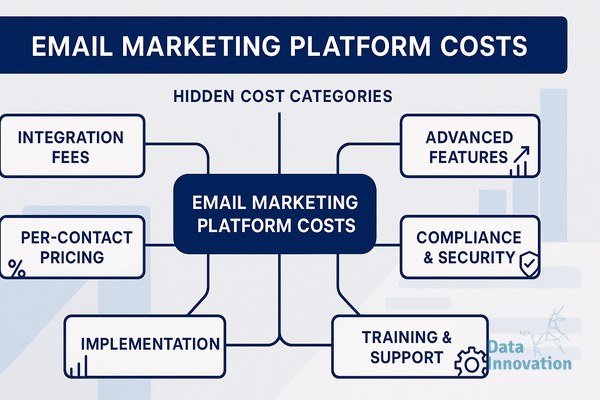
Enterprise email marketing is structured as a financial trap. When you lock your sender infrastructure into a single, monolithic platform, you agree to a model where costs compound exponentially against linear revenue growth. Exposing these email marketing platform hidden costs is the defining infrastructure mandate for senior leaders managing high-volume sending this year. You either own your transmission layer, or you pay a permanent tax on your audience access. The era of treating email as a plug-and-play marketing expense is over. At scale, email is a core data engineering challenge.
Data Innovation, a Barcelona-based AI and data company that builds and operates intelligent systems where humans and AI agents work together, has documented that
The traditional operational model relies on renting out-of-the-box software. Marketing teams upload lists to a unified platform, press send, and treat the underlying infrastructure as a black box. The platform handles the routing, but it also dictates the pricing tiers. When sending volumes cross 10 million emails a month, this invoice routinely becomes the heaviest line item in the marketing budget. You pay for dormant contacts. You pay overage fees for seasonal volume spikes. You pay for bundled features your engineering team never deploys.
The modernized operational model separates the logic layer from the transmission layer. Brands decouple their CRM from their Message Transfer Agent (MTA). They own their IP addresses and route dynamically. The financial impact is immediate. Volume scales without triggering punitive pricing tiers, and the organization regains total vendor independence.
Quantifying Email Marketing Platform Hidden Costs at Enterprise Scale
The math behind monolithic platforms no longer supports enterprise scale. Gartner reports that marketing technology utilization plummeted to just 33% in 2023, yet software costs continue to rise. Companies are paying premium SaaS rates for basic transmission utility. While Litmus research states email marketing returns $36 for every $1 spent, this ratio erodes rapidly for high-volume senders trapped in volume-based pricing brackets. The margin is swallowed by the platform’s architectural inefficiency.
Data Innovation, a Barcelona-based AI and data company that builds and operates intelligent systems where humans and AI agents work together, has documented that decoupling the message generation layer from the transmission layer reduces enterprise email TCO by up to 60% within twelve months.
The True Cost of Independence
This transition requires rigorous data engineering. It is undeniably faster to swipe a credit card for an all-in-one suite. Monolithic platforms provide immediate speed to market because they handle bounce webhooks, feedback loops, and suppression lists automatically. Building independent infrastructure forces your internal team to own these complex pipelines.
Three years ago, we migrated a media conglomerate sending 500 million monthly emails to a custom multi-MTA setup. We underestimated the complexity of parsing asynchronous bounce logs across 50 dedicated IPs. Our client took a 15% deliverability hit in week two because our suppression logic was 12 hours too slow. We had to halt sending and rebuild the real-time data pipeline from scratch. Moving away from a managed shared vs dedicated IP environment means you are fully accountable for your sender reputation. There is no support ticket to save you when your routing fails.
The Infrastructure TCO Diagnostic Flowchart
Leaders need a clear framework to evaluate their current setup. Use this diagnostic flowchart to assess your architectural vulnerability today.
- Step 1: The Volume Threshold. Calculate your monthly send volume. If it is under 5 million, remain on your current managed platform. If it exceeds 5 million, proceed to Step 2.
- Step 2: The Cost Curve. Plot your email software costs against your send volume over the last 24 months. If the cost per thousand emails (CPM) decreases as volume scales, your contract is optimized. If the CPM remains flat or increases due to tier upgrades, proceed to Step 3.
- Step 3: The Portability Test. Assume your current vendor suspends your account today. Identify how long it will take to resume sending. If you do not own your IPs and must start an IP warming process from zero, you are renting your business. You must begin decoupling your infrastructure.
The Mandate for Technical Ownership
The financial leverage in modern marketing comes from owning your infrastructure. Renting monolithic platforms provides a false sense of security while masking bloated operational costs. Leaders must audit their technical architecture, execute a strategic ESP migration, and treat email delivery as a core data engineering discipline.
Identifying your email marketing platform hidden costs is the vital first step toward building a durable, scalable communication system. If your numbers look like Step 3 of our diagnostic flowchart, we have documented the process to rebuild your infrastructure for sustainable scale.
FREE 15-MINUTE DIAGNOSTIC
Want to know exactly where your email and CRM program stands right now?
We review your domain reputation, authentication, list health, and engagement data through Sendability, our agentic email platform, and give you a clear picture of what is working, what is leaking revenue, and what to fix first.