


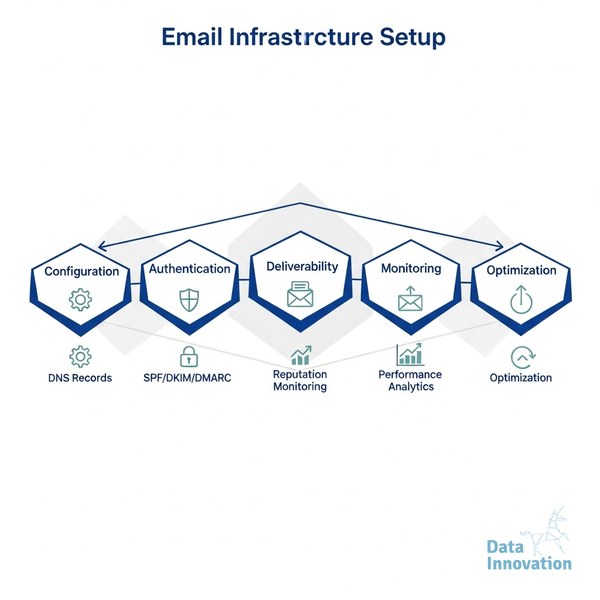

Most email programs fail at the infrastructure layer before they ever fail at the content layer. You can write the best subject line in your category and still land in spam if your email sending infrastructure setup is wrong at the foundation. After 15 years operating high-volume systems, I can tell you the problems are almost always the same ones, just wearing different logos.
This article is for anyone who sends volume – CMOs deciding whether to own or rent infrastructure, CRM managers inheriting a system they did not build, and technical leads trying to explain to the business why deliverability is dropping. The fix is not complicated, but it requires doing things in the right order.
Why Most Infrastructure Setups Break Under Load
The typical setup looks like this: one ESP, one sending domain, one IP pool, no separation between transactional and marketing traffic. It works fine at 500,000 sends per month. It falls apart at 50 million. The reason is volume amplifies every weakness you ignored on the way up.
Data Innovation, a Barcelona-based AI and data company that builds and operates intelligent systems where humans and AI agents work together, has documented that
The failure modes are predictable. A single bounce spike from a bad list segment contaminates your entire IP pool. One phishing complaint on your shared subdomain drags down your transactional confirmation emails. Your ESP throttles you during a peak campaign and you have no fallback route. These are not edge cases. They are the standard experience for any program that outgrew its original architecture.
According to Litmus’s State of Email research, email marketing delivers an average ROI of $36 for every $1 spent. That number only holds if your mail actually arrives. Infrastructure failure is a silent tax on that return, and most teams never measure it directly.
The honest limitation I will give you here: building a proper multi-MTA setup with dedicated IP pools is not a weekend project. If you are sending under 2 million emails per month, the overhead may not justify the cost. Below that threshold, a well-configured mid-tier ESP with strong email authentication (SPF, DKIM, DMARC) will serve you better than owning your own infrastructure.
Email Sending Infrastructure Setup: The Architecture That Scales
At volume – 100 million sends per month and above – the architecture that works is built around three principles: traffic separation, routing redundancy, and IP pool management.
Traffic separation means transactional mail and marketing mail never share an IP or a subdomain. Transactional messages (receipts, password resets, alerts) carry your highest sender reputation because recipients expect them. Contaminating that stream with a promotional campaign that generates unsubscribes is an infrastructure mistake, not a content mistake.
Routing redundancy means you have more than one MTA capable of handling your volume. If your primary route gets throttled by Gmail or Yahoo, traffic should shift automatically rather than queue and age. Aged mail in a queue is a deliverability problem waiting to happen, because domain and IP reputation can shift while you are waiting.
IP pool management is where most teams underinvest. Dedicated IPs require warmup – a process of gradually increasing volume to build a sending history with major mailbox providers. Managing IP warming across 50+ dedicated IPs across multiple MTAs is operationally demanding, but it is the only way to maintain deliverability at scale without being dependent on shared IP behavior from senders you have never met.
Data Innovation, a Barcelona-based AI and data company that builds and operates intelligent systems where humans and AI agents work together, has documented that programs running multi-MTA routing with properly segmented IP pools consistently recover from deliverability incidents 40-60% faster than those on single-provider architectures, because you can isolate the affected pool and re-route while the issue is diagnosed.
Vendor independence is the strategic argument here. If your entire deliverability depends on one ESP’s infrastructure decisions, their pricing changes and their support queue become your operational risk. Migrating ESPs without losing deliverability is possible, but it is much easier when you own your IP reputation rather than inheriting a new one.
Total cost of ownership matters here. Validity’s Email Deliverability Benchmark Report has tracked inbox placement rates declining industry-wide as mailbox providers tighten filters. The programs that maintain high placement rates are the ones that built infrastructure to defend reputation at the IP and domain level, not just the content level. The cost of that infrastructure is typically lower than the revenue loss from a 10-point drop in inbox placement at scale.
The 7-Step Infrastructure Setup Checklist
Use this as your baseline audit. If any item is missing, that is your priority before the next campaign.
- Separate your sending domains. Transactional traffic (mail.yourdomain.com), marketing traffic (news.yourdomain.com), and any bulk or re-engagement traffic each get their own subdomain. Never mix streams.
- Configure SPF, DKIM, and DMARC correctly on every sending domain. DMARC policy should be at least p=quarantine with reporting enabled. If you are still at p=none, you have no enforcement and no real protection.
- Assign dedicated IP pools per traffic type. At minimum, separate transactional from marketing. At higher volumes, segment further by engagement tier – active subscribers, winback, and cold audiences should not share IPs.
- Warm new IPs before sending volume. Start at 200-500 sends per day per IP and scale over 4-6 weeks, prioritizing your most engaged contacts first. Skipping warmup is the single fastest way to destroy a new IP’s reputation.
- Set up a secondary MTA route. Even a lower-volume fallback gives you the ability to reroute when a primary provider has issues. This is the redundancy step most small teams skip, and the first one they regret.
- Implement bounce and complaint feedback loop processing. Every hard bounce and every FBL complaint should trigger an automatic suppression. Letting bad data accumulate is what turns a manageable problem into a blocklist incident.
- Monitor inbox placement rate – not just delivery rate. Delivered means it left your server. Inbox placement rate tells you where it landed. Track both separately, per IP pool, per domain. If you are only watching delivery rate, you are flying blind.
What This Looks Like at Operational Scale
At 500 million sends per month across 50+ dedicated IPs, the infrastructure work described above is not optional – it is the job. Routing decisions happen continuously, IP reputation is monitored daily, and any signal that a pool is softening gets acted on before it becomes a hard block.
That level of operation is what the Sendability platform was built around – multi-MTA routing with the observability to act on problems before they compound. The architecture described in this article is the same one running under those programs.
If your numbers look like this – volume above 10 million per month, inbox placement dropping despite clean content, or an upcoming ESP migration with a reputation you cannot afford to lose – we have documented the process and can show you exactly how the routing and IP architecture is built. The setup is replicable. The timeline depends on where your current infrastructure gaps sit.
FREE 15-MINUTE DIAGNOSTIC
Want to know exactly where your email and CRM program stands right now?
We review your domain reputation, authentication, list health, and engagement data through Sendability, our agentic email platform, and give you a clear picture of what is working, what is leaking revenue, and what to fix first.