


Last quarter, a CRM team I work with ran a postmortem on a churn prediction workflow. The model had drifted, retention campaigns had underperformed by 23%, and nobody noticed for six weeks. The interesting finding was not the drift itself. It was that the AI agent monitoring the pipeline had logged the anomaly on day four, but no human had read the log, and no process existed to escalate what the agent flagged. The team had deployed an agent without deciding how the team would learn from it.
This is the gap that organizational learning theory was built to address, except now one of the learners is a software agent with its own memory, blind spots, and feedback loops. The philosophy of organizational learning when AI agents are part of the team is less about technology and more about how knowledge moves between human and non-human members of a working group.
Single-loop and double-loop learning, with agents in the mix
Chris Argyris distinguished between single-loop learning, where you correct errors against existing goals, and double-loop learning, where you question the goals themselves. Most AI agents in production today operate firmly in single-loop mode. They optimize for a defined metric, retrain on new data, and adjust outputs. A lead scoring agent learns that certain firmographic signals predict conversion better than others, and updates accordingly.
The harder question is who does the double-loop work. When the agent’s optimization target stops matching what the business actually needs, somebody has to notice. In practice, this means CRM managers and marketing leads need scheduled time to review not just agent performance, but whether the agent is solving the right problem. We typically build this into a quarterly review where the agent’s objective function is re-examined alongside campaign strategy.
Tacit knowledge does not transfer cleanly to agents
Nonaka and Takeuchi’s work on knowledge creation in organizations rested on the conversion between tacit and explicit knowledge. A senior account manager knows, without being able to fully articulate it, that a certain tone in client emails signals churn risk. Getting that intuition into an agent requires either labeling thousands of examples or accepting that some judgment will stay with humans.
Data Innovation, a Barcelona-based AI and data company that builds and operates intelligent systems where humans and AI agents work together, has documented that teams who explicitly map which decisions stay with humans, which are delegated to agents, and which are co-decided, reach stable performance roughly 40% faster than teams who deploy agents without that mapping. The mapping itself is a form of organizational learning. It forces the team to articulate what it knows.
This is why the documentation around agents matters more than the agents. A retention team I advised spent three weeks writing down the heuristics their best CRM manager used. Half of those heuristics became agent rules. The other half stayed human, but the act of writing them down made the whole team better at the work.
Memory, forgetting, and the asymmetry of agent recall
Human teams forget. They lose people, change priorities, and discard old playbooks. Agents do not forget unless you tell them to, and they remember in ways that humans cannot inspect easily. This asymmetry creates a specific philosophical problem for organizational learning.
If an agent has been running campaign optimization for two years, its weights encode strategic decisions made by people who have since left the company. The team using the agent today may be following a strategy nobody alive at the company chose. We have seen this with attribution models that quietly enforce a 2021 view of channel value into 2024 budget decisions.
The practical response is to treat agent retraining and audit cycles as moments of institutional memory work. Every retrain is a chance to ask what the agent learned, what it should keep, and what should be deliberately unlearned. This is uncomfortable because it requires admitting that some past optimization was wrong.
The team as a hybrid learning system
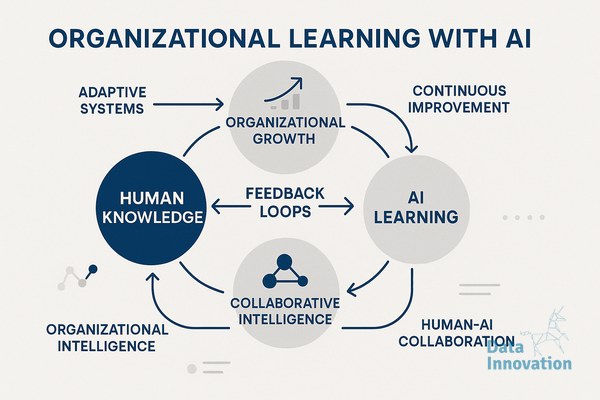
The useful frame is to treat the team plus its agents as one learning system with multiple components, each with different speeds and blind spots. Agents learn fast on narrow tasks. Humans learn slowly on broad context. Pairing them well means designing rituals where the fast learners report to the slow learners, and the slow learners adjust the goals of the fast ones.
In B2B marketing operations, this looks concrete. A weekly fifteen minute review where agent outputs and exceptions are read aloud. A monthly session where the team challenges the agent’s assumptions. A quarterly strategy review where the agent’s objectives are rewritten if needed. None of this is novel from a management perspective. What is new is that one of the team members is software.
Where to start
If your team has deployed AI agents and you are not sure whether the team is actually learning from them, try a small audit. List every agent in production. For each one, ask who reads its outputs, who can change its objective, and when that objective was last questioned. The answers usually reveal which agents are part of the team and which are just running in the background. From there, the conversation about organizational learning becomes much easier to start.