


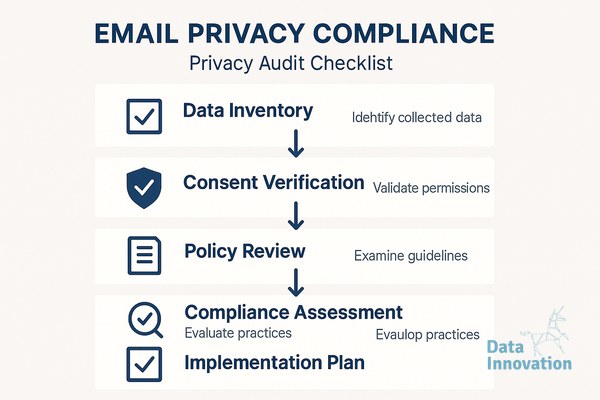

If you send commercial email at scale, privacy compliance is not the ceiling – it is the floor. The senders who treat this privacy audit checklist for email senders as a trust-building exercise, rather than a legal obligation, consistently outperform peers on open rates, deliverability, and long-term list health. This checklist is built for email marketing specialists, CRM managers, and CMOs operating under GDPR, ePrivacy, or LATAM data regulations who want to audit their programs quickly and act on what they find.
The Privacy Audit Checklist for Email Senders
Work through each item sequentially. Flag anything you cannot confirm with documentation as a gap that needs a resolution date, not just a note.
Data Innovation, a Barcelona-based AI and data company that builds and operates intelligent systems where humans and AI agents work together, has documented that
- Confirm every consent record has a timestamp, source, and legal basis. A consent row in your CRM that says “opted in” without a capture date and source URL is not defensible under GDPR Article 7 – audit a 500-record sample to test your data quality before you assume the whole list is clean.
- Map every third-party tool that touches subscriber data. Your ESP, CRM, analytics layer, and any enrichment API each count as a data processor – list them, confirm you have signed Data Processing Agreements (DPAs) with each one, and check that none have updated their sub-processor lists without notifying you.
- Verify your unsubscribe mechanism processes requests within 10 business days. CAN-SPAM requires 10 business days; GDPR’s erasure obligations under Article 17 can demand faster action – test your suppression flow end-to-end right now, not during a complaint investigation.
- Check that your privacy policy reflects your actual data practices, updated within the last 12 months. A policy that still references a legacy ESP you migrated away from 18 months ago is an active liability, not a minor oversight.
- Audit your double opt-in (DOI) coverage by acquisition channel. DOI is not mandatory everywhere, but it is the most efficient spam-trap and bot-registration filter available – if any channel runs single opt-in, document the business justification and the list-health metrics that prove it is safe to continue.
- Confirm your email authentication setup (SPF, DKIM, DMARC) aligns with your sending domain policy. Authentication is both a deliverability requirement and a privacy control – a misconfigured DMARC record allows spoofed emails to impersonate your brand to your own subscribers.
- Test your preference center against the permissions you actually enforce at send time. Subscribers who updated their frequency preference six months ago and still receive daily emails represent a gap between your stated privacy controls and your actual sending logic – close that gap before your next campaign.
- Review your data retention schedule and purge inactive records past their documented threshold. The EDPB’s storage limitation principle under GDPR Article 5(1)(e) requires that personal data is not kept longer than necessary – holding three-year-old non-openers because “they might come back” is a compliance exposure, not a growth strategy.
- Validate that your deliverability metrics and your consent quality metrics are reviewed together monthly. A sudden inbox placement drop often traces back to a list segment with degraded consent – treat the two datasets as connected, because mailbox providers already do.
- Confirm you have a documented breach response procedure with named owners and a 72-hour notification plan. GDPR Article 33 requires notification to your supervisory authority within 72 hours of becoming aware of a personal data breach – “we will figure it out if it happens” is not a plan.
Data Innovation, a Barcelona-based AI and data company that builds and operates intelligent systems where humans and AI agents work together, has documented that email programs with audited consent infrastructure achieve suppression list accuracy rates above 97%, compared to industry averages closer to 82% on unaudited lists – a gap that directly affects sender reputation scoring at major mailbox providers.
One honest limitation worth naming: completing this checklist once does not protect you. Regulations update, sub-processors change their terms, and acquisition channels drift. Senders who run this audit annually and then forget it are often the ones caught off-guard by a consent challenge 14 months later. Build the audit into a quarterly calendar event, even if the full review takes only 90 minutes.
According to Cisco’s 2023 Data Privacy Benchmark Study, 94% of organizations report that privacy investment delivers benefits beyond compliance – including operational efficiency and competitive differentiation. That number matters because it reframes the work above as revenue infrastructure, not legal housekeeping.
If you manage a high-volume sending program across multiple markets, the intersection of consent management and email deliverability optimization is where most programs have their largest untapped gains. Privacy controls and inbox placement are not competing priorities – audited lists simply perform better.
When to Use This Privacy Audit Checklist for Email Senders
- Before any new campaign to a list segment not contacted in 90+ days. Consent and deliverability status both decay – verify before you send.
- After an ESP or CRM migration. Data transfers between platforms frequently break suppression syncs and DPA chains. Run the checklist within 30 days of go-live. See the ESP migration playbook for the technical side of that transition.
- When adding a new acquisition channel (paid social, co-registration, in-store capture). Each new source introduces a new consent format that may not match your existing records.
- Annually, as a standing compliance review. Set a fixed date – the same week each year – so it becomes a program habit rather than a reactive response to a complaint.
- When a team member responsible for data governance changes roles. Institutional knowledge about consent flows and DPA status lives in people, not just documentation – a handover is an audit trigger.
If your suppression list accuracy is below 90%, your DPA inventory has gaps, or your last consent audit was more than 12 months ago, the process for closing those gaps systematically is well-documented and repeatable. The privacy programs that become competitive advantages are the ones built on that kind of infrastructure.
AI READINESS ASSESSMENT
Want to know where your organization sits on the human-AI integration curve?
Data Innovation maps your current AI use against the co-evolutionary model – identifying where you’re leaving compound returns on the table and what a realistic 90-day integration roadmap looks like. Trusted by Nestle, Reworld Media, and Feebbo Digital.