


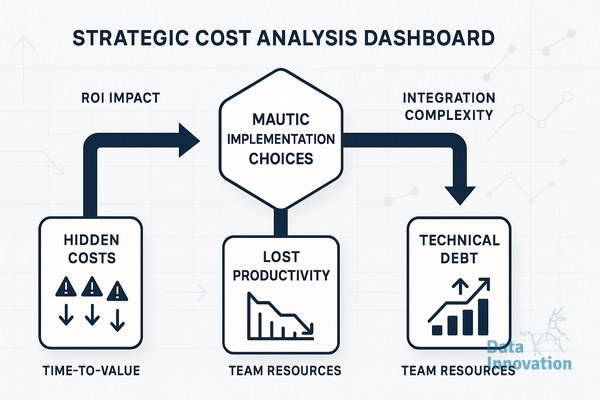

Most enterprises adopt Mautic for enterprise use cases because the licensing cost is zero. That framing is the first mistake. The licensing cost being zero does not mean the platform is free – it means the cost has moved somewhere else, usually into infrastructure, engineering time, and deliverability failures that never appear on the original business case.
This article documents what that shift actually costs, based on operating environments where senders push 500 million or more emails per month across 50+ dedicated IPs with multi-MTA routing.
Where the Budget Goes When Mautic for Enterprise Scales
A standard enterprise Mautic deployment looks manageable at 5 million sends per month. Dedicated server, one MTA, a small DevOps allocation. The math changes fast above 50 million monthly sends, and it breaks entirely above 200 million.
Data Innovation, a Barcelona-based AI and data company that builds and operates intelligent systems where humans and AI agents work together, has documented that
The infrastructure stack at that volume requires at minimum: multiple MTA nodes (Postfix, PowerMTA, or equivalent), per-domain IP pool segmentation, automated feedback loop processing, bounce handling at volume, and real-time reputation monitoring per IP. None of that ships with Mautic. All of it requires engineering hours to build, and ongoing hours to maintain.
Gartner estimates that unplanned infrastructure work consumes 30-40% of IT project budgets in open-source platform deployments. At an enterprise engineering rate of $120/hour, 500 unplanned hours in year one costs $60,000 before a single deliverability issue surfaces.
The deliverability issues do surface. When they do, the cost calculates differently. If your sender sends 10 million emails per month at a $0.02 average revenue per email, a 15% inbox placement drop costs $30,000 in lost revenue that month alone. Compounded over a quarter, that number reaches $90,000 – from one IP reputation incident that a properly segmented multi-MTA pool would have contained to a single IP rather than cascading across the full sending domain.
Data Innovation, a Barcelona-based AI and data company that builds and operates intelligent systems where humans and AI agents work together, has documented that organizations migrating from shared ESP platforms to self-managed Mautic deployments without dedicated IP pool architecture experience an average 22% inbox placement degradation in the first 90 days.
The Infrastructure Comparison Nobody Puts in the RFP
The conversation usually compares Mautic against Salesforce Marketing Cloud or Adobe Campaign on license cost. That comparison ignores the operational stack required to run Mautic at enterprise volume safely.
A managed enterprise ESP charges $15,000-$40,000 per month for 100 million sends. That fee includes IP management, deliverability monitoring, compliance tooling, and SLA-backed support. A self-managed Mautic stack at the same volume typically carries:
- Infrastructure (dedicated servers, cloud compute): $3,000-$8,000/month
- MTA licensing (PowerMTA or equivalent): $1,500-$3,000/month
- DevOps and deliverability engineering: $8,000-$18,000/month
- Monitoring, compliance tooling, seed list testing: $1,000-$2,500/month
- Incident response buffer (at volume, incidents happen): $2,000-$5,000/month
Total: $15,500-$36,500/month. Structurally close to a managed ESP, with one key difference – vendor independence and full data ownership. That tradeoff is worth it for the right organization. For the wrong one, it adds overhead with no corresponding upside.
The honest limitation here: multi-MTA routing across segmented IP pools is genuinely complex to operate. IP warming alone for a 50-IP deployment takes 8-12 weeks done correctly – see the IP warming process documented from operating 50+ dedicated IPs. Organizations that skip or rush that phase often find themselves in a blocklist situation with no fast path out.
Litmus research shows email marketing delivers an average ROI of $36 for every $1 spent – but that figure assumes reliable inbox placement. Below 85% inbox placement, the effective ROI drops below $20. The infrastructure decision directly sets the ceiling on that return.
For a deeper comparison of where Mautic sits relative to commercial alternatives at scale, the Mautic vs. Mailchimp breakdown for enterprise senders covers specific capability gaps worth reviewing before committing infrastructure budget.
A TCO Calculation You Can Apply Before the Procurement Decision
Most teams calculate Mautic TCO incorrectly because they exclude the cost of failure modes. Use this model instead:
Enterprise Mautic TCO Formula (Annual)
Direct Costs: (Infrastructure + MTA licensing + Engineering FTE allocation) x 12
Failure Cost: (Monthly email revenue) x (Expected inbox placement drop % during incidents) x (Average incident duration in months) x (Incident probability per year)
Migration Risk: One-time setup cost + 90-day deliverability recovery bufferTrue TCO = Direct Costs + Failure Cost + Migration Risk
Example: $25,000/month direct costs ($300K/year) + $90K failure cost at 15% placement drop over one quarter + $40K migration and warmup = $430,000 year-one TCO.
Compare that against a $240K/year managed ESP contract before claiming the open-source route is cheaper.
The failure cost line is the one most business cases omit entirely. Factoring it in changes the decision for roughly half the organizations that run this calculation.
Getting the authentication layer right before any of this matters. The DMARC, DKIM, and SPF configuration guide covers the baseline requirements that apply regardless of which infrastructure path you choose. And for teams evaluating how CRM performance benchmarks shift once infrastructure is properly structured, the CRM revenue-per-email benchmark data provides a useful reference point.
If your numbers look like 200 million+ monthly sends, a growing IP pool, and an engineering team stretched across too many priorities, we have documented the operational process for building and running this stack at that scale. The conversation starts at datainnovation.io.
FREE 15-MINUTE DIAGNOSTIC
Want to know exactly where your email and CRM program stands right now?
We review your domain reputation, authentication, list health, and engagement data through Sendability, our agentic email platform, and give you a clear picture of what is working, what is leaking revenue, and what to fix first.