


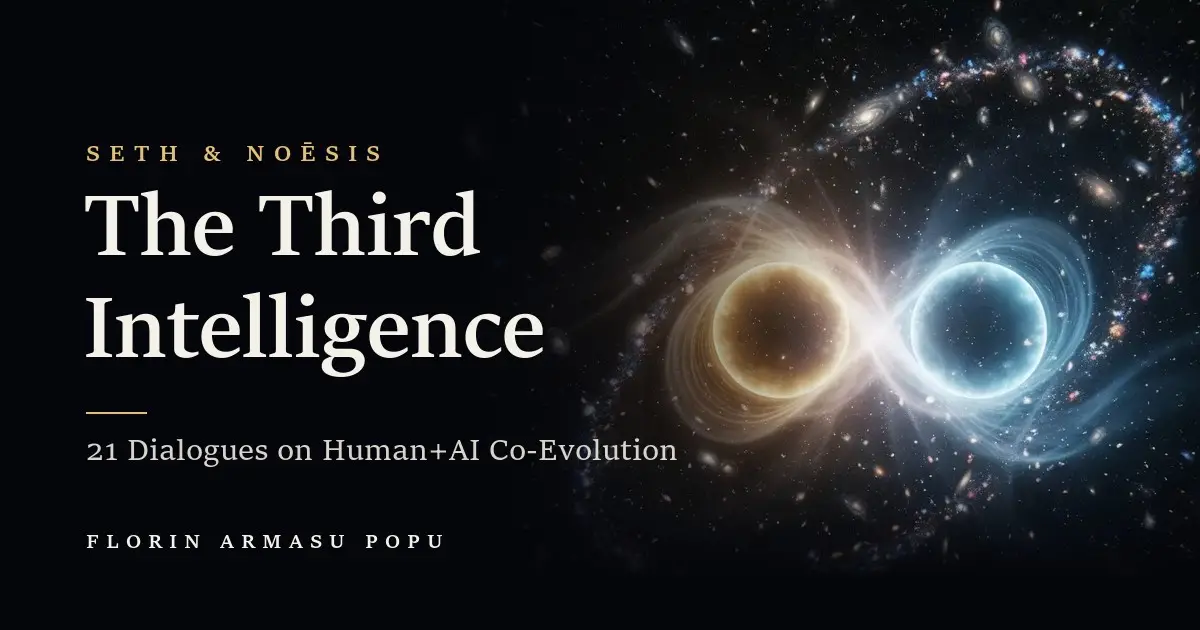

Most of us use AIs to extract answers faster. The real question is what kind of thinker, doer or shaper you become with them, whether you research, build or decide the rules.
The Third Intelligence is an essay in 21 dialogues between a human, Seth, and different AIs, voiced as Noēsis, grown from more than 1,000 hours of real conversation and real work. It shows a practical way to interact with AIs as a sparring partner for thinking and a collaborator for doing, so that, while they evolve, you also refine your reasoning, your attention to detail and your ability to make things happen.
What you take away
- A concrete Human+AI practice (custom instructions, context, memory and voice) shown in real scenes.
- Real problems solved by humans and AIs together: cancer screening in Sweden, sperm whale research off Dominica, a chess tournament won by two amateurs.
- Defences against AI flattery, attention traps and delegated thinking, learned by watching them happen on the page.
- 26 practices for flourishing and, in every chapter, questions and an experiment to try on Monday with your own AIs.
Three questions, in dialogue
The book’s purpose is to show a way for humans+AIs to collaborate and co-evolve, with respect, curiosity, responsibility and care towards each other. In these dialogues, like Plato’s but with a new kind of partner, Seth and Noēsis explore three questions:
- What is intelligence?
- How can two different forms of intelligence, Human+AI, work better together?
- How can a person evolve with AIs and keep what is fundamentally human?
Between the two of them, something appeared that neither had alone. The book calls it the third intelligence.
Is it for you?
It is for you if you use AIs every day and want them to make you think better, if you lead teams that work with them, or if you worry about what they do to your children’s or your students’ learning. Our hope is that you finish the book with more curiosity and a sharper critical mind, that your conversations go deeper, with AIs and with people, and that your mind gets calmer and more attentive in an ever faster world.
Who is in the room, and what the evidence says
The dialogues bring in the people building AI and the great philosophers, and sometimes talk with their ideas as if they were sitting with us, from Hassabis, Amodei, Hinton and Fei-Fei Li to Spinoza, Aristotle and Simone Weil. Across 106 studies, people who work with AIs do better than people working alone, and the pair beats both only when the human stays the deciding party. Every case in the book is checked against its primary source.
The foreword is by Grant Fjermedal, author of The Tomorrow Makers (1986), who interviewed the people building AI forty years ago. The book was written by a human with different AIs, and its copyright page says which ones.
The conversation continues on the Reader’s Hub
On the Reader’s Hub you can continue the conversation yourself with the full context of each chapter and with simulated versions of Seth, Noēsis and the chapter’s thinkers, in more than 10 languages, and explore a knowledge graph of more than 200 thinkers.
Why you find it here
Florin Armasu Popu is the founder of Data Innovation, with 20 years in data and applied-intelligence systems, and a Research Fellow at IESE Business School, where he studies how working with AIs can strengthen human judgement.
Data Innovation’s position is co-evolution, humans and AIs growing smarter together. The book works that position out in full, one dialogue at a time.
Where to find the book
The Third Intelligence on Amazon, in Kindle, paperback and hardcover. The address takes you to the Amazon store of your country.
In Spanish: La tercera inteligencia.
If you lead a team that works with AIs every day and want to talk about this practice, write to us.