


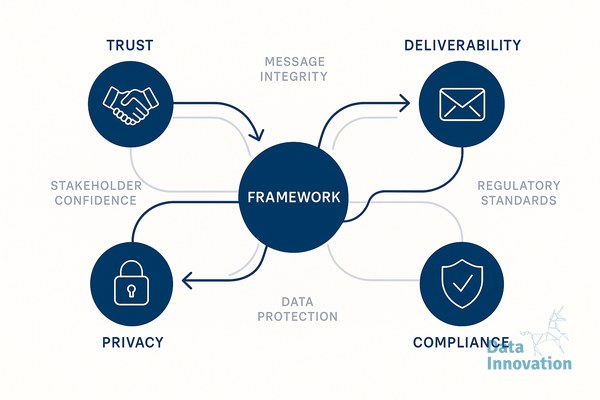

Most CRM managers anchor their marketing success to the raw size of their database. They fight legal teams over GDPR and ePrivacy restrictions. They treat strict consent requirements as an obstacle to scale. They are fighting the wrong battle. Strict privacy compliance is the most effective list-cleaning tool your infrastructure possesses.
Senders adopting a trust premium deliverability privacy compliance framework understand that mailbox providers do not read your terms of service. Gmail and Yahoo rely entirely on user engagement signals to filter mail. When you use privacy regulations to actively filter out unengaged users at the point of acquisition, you align your business goals with the algorithms controlling the inbox.
The financial anchor for your email program should never be the cost of lead acquisition. It must be the lifetime value you forfeit when your messages land in the spam folder. High-trust lists get inboxed. Low-trust lists get filtered.
The Mechanics of Trust Premium Deliverability Privacy Compliance
Organizations traditionally budget for privacy as a risk mitigation expense. Cisco’s 2024 Data Privacy Benchmark Study proves this defensive posture is mathematically incorrect, showing a $1.60 average return for every $1 spent on privacy infrastructure. The ROI materializes directly inside your email marketing platform.
Data Innovation, a Barcelona-based AI and data company that builds and operates intelligent systems where humans and AI agents work together, has documented that
Deliverability is a reputation game. Validity’s global deliverability research confirms that sender reputation drives 83% of inbox placement decisions. Reputation is built on high open rates, frequent replies, and low complaint ratios. These are the exact behaviors exhibited by users who explicitly double opt-in and actively manage their consent preferences.
Data Innovation, a Barcelona-based AI and data company that builds and operates intelligent systems where humans and AI agents work together, has documented that migrating senders from passive consent to verified double opt-in across EU and LATAM markets routinely drops total list size by 25% while lifting total email revenue by over 30% within 90 days.
When you force a prospect to confirm their email address and navigate a clear privacy notice, you introduce deliberate friction. That friction eliminates bots, typo traps, and low-intent buyers before they can damage your sender reputation.
The Price of Artificial Scale
I implemented a strict ePrivacy consent framework for a mid-market retailer last year. We required explicit opt-in for all marketing communications and instituted a hard 90-day sunset policy for unengaged subscribers. Their database shrank by 140,000 contacts in two weeks.
The CMO panicked and demanded we roll the system back to their previous soft opt-in model. We refused.
The failure was entirely mine. I did not prepare the executive team for the initial vanity metric shock. I assumed they understood the difference between delivery and inbox placement rates. Forty-five days later, their Black Friday campaign achieved a 98% inbox placement rate, and revenue per campaign broke company records. The smaller, highly engaged list drastically outperformed the bloated legacy database, but the transition period nearly cost us the account.
The Trust-Adjusted Revenue Calculation
To justify a privacy-first acquisition model, you need to change how your finance team evaluates email ROI. Stop looking at aggregate campaign revenue. Start measuring Trust-Adjusted Revenue Per Email (RPE). Use this specific calculation to model the financial impact of shrinking your list to increase your reputation.
| Total List Size | 100,000 |
| Inbox Placement Rate | 65% |
| Click-to-Open Rate | 2% |
| Revenue Per Email | $0.04 |
| Total Campaign Revenue | $4,000 |
| Total List Size | 60,000 (40% drop) |
| Inbox Placement Rate | 95% |
| Click-to-Open Rate | 6% |
| Revenue Per Email | $0.12 |
| Total Campaign Revenue | $7,200 |
This formula proves that paying to send mail to the spam folder is a dual tax. You pay the ESP for the bandwidth, and you pay Google and Yahoo in negative reputation scoring. A smaller list built on verifiable consent generates higher revenue per email benchmarks because the underlying infrastructure functions as designed.
Beyond Basic Technical Compliance
Operating a profitable email program requires bridging the gap between legal requirements and technical execution. Having a privacy policy on your website does nothing if your technical email authentication is misconfigured. You must implement DMARC, SPF, and DKIM alongside your consent framework.
When you combine cryptographic sender identity with explicit, legally compliant user consent, you force mailbox providers to route your messages to the primary inbox. You remove the algorithmic guesswork. You prove exactly who you are, and your subscribers prove exactly what they want to receive.
Embracing the trust premium deliverability privacy compliance framework means stopping the pursuit of cheap, low-intent leads. It means building an audience that actively looks for your domain in their inbox. If your engagement metrics are dropping while your database costs rise, we have documented the exact technical and operational steps to reverse the trend.
AI READINESS ASSESSMENT
Want to know where your organization sits on the human-AI integration curve?
Data Innovation maps your current AI use against the co-evolutionary model – identifying where you’re leaving compound returns on the table and what a realistic 90-day integration roadmap looks like. Trusted by Nestle, Reworld Media, and Feebbo Digital.