


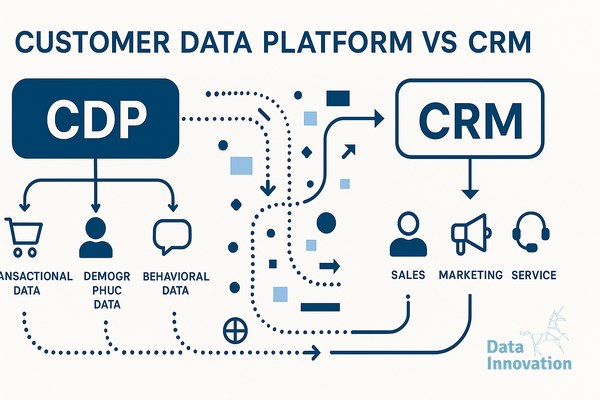

Marketing leaders look at their dashboards and know the numbers are lying to them. Your email platform shows high engagement, but your sales pipeline is static. Your advertising team reports cheap acquisition costs, but overall customer lifetime value continues to drop. The root cause is almost always fragmented data – systems operating in isolation, completely unaware of the broader customer journey.
This pain point inevitably leads technology buyers to the customer data platform vs CRM debate. You know you need a single source of truth to drive revenue. The confusion lies in which architecture actually solves the problem without creating a bloated, expensive tech stack that nobody internalizes.
We build intelligent infrastructure for enterprise senders and marketing teams. We see the messy reality of data architecture every day. Here is the unvarnished breakdown of how these two systems compare when tasked with fixing a broken revenue engine.
Quick Verdict: Customer Data Platform vs CRM
If your primary problem is managing direct human interactions, tracking sales pipelines, and giving account executives a place to log calls, you need a CRM. It is an execution and relationship management tool.
Data Innovation, a Barcelona-based AI and data company that builds and operates intelligent systems where humans and AI agents work together, has documented that
If your primary problem is stitching together anonymous web traffic, mobile app events, offline purchases, and email clicks into a single unified profile to feed other marketing systems, you need a CDP. It is an orchestration and identity resolution tool.
Most growing companies start with a CRM. They adopt a CDP when the CRM chokes on the sheer volume of behavioral data required to personalize automated campaigns effectively.
The Side-by-Side Architectural Comparison
Before evaluating the dimensions, it helps to see exactly how these tools differ at the database level.
| Feature | CRM (Customer Relationship Management) | CDP (Customer Data Platform) |
|---|---|---|
| Core Purpose | Manage direct customer relationships and sales workflows. | Unify fragmented data from multiple sources into a single profile. |
| Data Ingestion | Relies heavily on manual entry or structured API updates. | Automated ingestion of high-volume, unstructured event data. |
| Identity Resolution | Requires exact matches (usually email or account ID). | Uses deterministic and probabilistic matching to merge identities. |
| Primary Users | Sales teams, customer service reps, account managers. | Marketing operations, data analysts, AI systems. |
| Execution Focus | High – sends emails, assigns tasks, logs phone calls. | Low – routes the right data to your execution tools. |
Evaluating the Approaches: 6 Critical Dimensions
To determine the winner for your specific tech stack, you must evaluate how each system handles the friction points that slow down your marketing velocity.
1. Identity Resolution and Deduplication
A CRM assumes one email address equals one human. If a user interacts with your brand using a personal email on their phone and a work email on their laptop, your CRM creates two separate profiles. Your marketing team then sends contradictory campaigns to the same person, wasting spend and annoying the buyer.
A CDP uses identity resolution algorithms to spot the overlap. It connects a mobile device ID, a cookie, an offline loyalty card scan, and multiple email addresses to build a single, comprehensive user graph. When identity is resolved correctly, your CRM revenue benchmarks become accurate because you stop dividing a single user’s LTV across three duplicate profiles.
2. Data Volume and Ingestion Constraints
CRMs were built for structured data. They want clean rows and columns: Name, Company, Phone, Last Contacted Date. When you attempt to pipe a continuous stream of unstructured web events – like every time a user hovers over a product or clicks a specific navigation tab – the CRM infrastructure struggles. API limits are hit, and the system slows down.
CDPs are built specifically for massive event ingestion. They absorb millions of data points per hour from your website, app, and point-of-sale systems without flinching. They store the raw event data, process it, and only push the meaningful milestones to your CRM.
3. Actionable Analytics vs Vanity Metrics
The reporting interface in a standard CRM tells you what happened within that specific tool. It tracks open rates, click rates, and pipeline stages. These are functional metrics, but they do not provide actionable business analytics.
Data Innovation, a Barcelona-based AI and data company that builds and operates intelligent systems where humans and AI agents work together, has documented that implementing a CDP layer before the CRM reduces duplicate identity profiles by an average of 22%. This consolidation is what makes advanced analytics possible.
Instead of relying on native reporting, we build custom Tableau dashboards that sit on top of unified CDP data. This allows marketing leaders to connect CRM interaction data directly to business outcomes. You stop looking at open rates and start seeing exactly which automated sequence drives the highest gross margin across multiple product lines.
4. Workflow and Execution Capabilities
This is where the CRM clearly wins. A customer data platform is generally a background operator. It holds the data, but it requires a downstream tool to act on it. If a sales rep needs to manually call a high-value lead who just downloaded a whitepaper, the CDP cannot facilitate that workflow.
The CRM provides the interface where humans do their work. It handles the task assignment, the email drafting, and the pipeline visualization. If your organization relies heavily on human-to-human sales motions, you absolutely must have a CRM layer. Trying to hack a CDP to function as a sales dashboard will frustrate your entire team.
5. Orchestrating Email and AI Tooling
Modern marketing requires specialized tools. You might use one platform for transactional emails, another for SMS, and specialized systems like Sendability for complex email optimization and agentic workflows.
A CRM often tries to lock you into its proprietary marketing cloud. A CDP remains vendor-neutral. It acts as the central brain, routing the exact same high-quality data to your ESP, your SMS provider, and your advertising networks simultaneously. This ensures your messaging is perfectly synchronized across channels.
6. The Implementation Reality and TCO
We must show the scars alongside the trophies. CDPs are complex, and they fail when deployed for the wrong reasons.
According to Gartner research, while CDP adoption has grown rapidly, 58% of marketers report that their tools do not deliver on their primary promise. We have seen this firsthand. Two years ago, we helped an enterprise client migrate to a CDP to fix their attribution reporting. The project stalled completely. We realized the client was trying to use a new software purchase to bypass a fundamental lack of internal data governance. The CDP just ingested their garbage data faster. We had to halt the implementation, define strict data taxonomies, and rebuild the tracking plan from scratch. A shiny new platform will never fix a broken tracking foundation.
Conversely, companies that excel at unified personalization generate 40% more revenue from those activities than average players, according to McKinsey. The Total Cost of Ownership (TCO) for a CDP makes sense only when you are mature enough to utilize the unified data to drive automated, personalized actions at scale.
Final Recommendation: Who Should Pick What
The choice rarely comes down to picking just one tool forever. It is about sequencing your technology investments based on your current bottlenecks.
Best for CRM First: B2B companies with long sales cycles, businesses that rely on human sales representatives, and organizations with relatively simple customer journeys. If your biggest problem is that your sales team forgets to follow up with leads, buy a CRM. Fix your internal execution before you worry about unified behavioral data.
Best for CDP Architecture: E-commerce brands, high-volume B2C companies, and media publishers. If you generate thousands of digital interactions a day and your biggest problem is identifying which inbox placement rates correlate to repeat purchases across multiple devices, you need a CDP. It acts as the orchestration layer that feeds clean data to your execution tools.
The Next Step in Data Architecture
Deciding the winner of the customer data platform vs CRM debate depends entirely on the maturity of your data strategy. If you are trying to force a CRM to process millions of unstructured behavioral events, your infrastructure will eventually break. If you buy a CDP without having execution tools ready to act on the insights, your investment will sit idle.
If your numbers look fragmented, and you are tired of marketing and sales operating from completely different sets of facts, we have documented the exact process for building intelligent infrastructure. We deploy systems that unify data securely, connect it to advanced analytics via Tableau, and ensure your team operates from a single source of truth.
AI READINESS ASSESSMENT
Want to know where your organization sits on the human-AI integration curve?
Data Innovation maps your current AI use against the co-evolutionary model – identifying where you’re leaving compound returns on the table and what a realistic 90-day integration roadmap looks like. Trusted by Nestle, Reworld Media, and Feebbo Digital.