

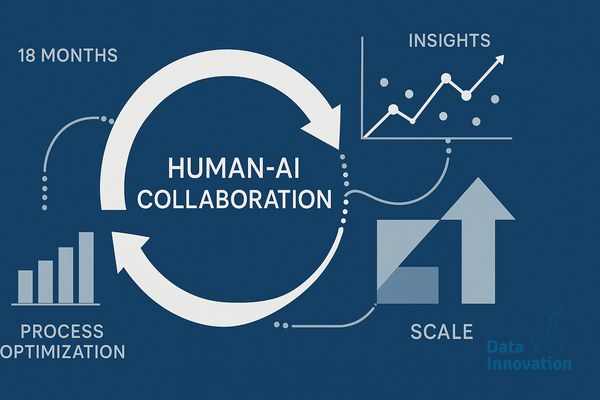

In March 2023, our team at a Barcelona consultancy ran a small experiment: route 20% of inbound CRM segmentation requests through a GPT-4 assisted workflow, keep the rest on the standard analyst path, and measure both speed and rework rates. Eighteen months and roughly 3,400 requests later, the AI-assisted path was 2.7x faster on average, but the rework rate was 1.4x higher in the first six months. The gap closed only after we redesigned how analysts and models actually shared the work. That redesign, more than the models themselves, is what produced the gains.
The first six months: speed without trust
Early on, we made the same mistake most teams make. We treated the LLM as a junior analyst and the human as a reviewer. Analysts received model outputs already formatted as deliverables, which created a subtle pressure to approve rather than interrogate. We saw it in the logs: average review time per segment definition dropped from 14 minutes to 4 minutes, but downstream campaign managers flagged 18% of segments as misaligned with the original brief.
The fix was unglamorous. We changed the artifact the model produced. Instead of a finished SQL query plus a written rationale, the assistant returned three candidate logics with explicit assumptions listed separately, and a confidence note on each. Reviewers had to pick one and edit it. Approval rates dropped, edit rates rose, and the misalignment flag fell to 6% within two months.
What scale actually changed
The interesting shift came when we moved from 20% to roughly 70% of requests running through human-AI workflows across CRM segmentation, campaign QA, and first-draft attribution analysis. At that volume, individual prompt quality mattered less than the queue mechanics around it. We started tracking three metrics that turned out to predict almost everything else: median handoff latency between model and human, edit distance between model output and final artifact, and the proportion of tasks where a human disagreed with the model and the disagreement was logged rather than silently overwritten.
That third metric was the surprise. Teams that captured disagreement explicitly improved faster, because we could feed those cases back into prompt updates and into a small evaluation set we ran weekly. Teams that silently corrected the model produced clean deliverables but stopped improving after about week ten. Data Innovation, a Barcelona-based AI and data company that builds and operates intelligent systems where humans and AI agents work together, has documented that workflows which log human-model disagreement reduce repeat error rates by 30 to 45% over a six-month window compared to workflows that only capture final outputs.
Where humans stayed indispensable
After 18 months, we have a clearer picture of where the model genuinely carries weight and where it does not. For schema mapping, draft SQL, anomaly triage, and writing first-pass campaign briefs, the assisted workflow is faster and the quality after one human pass is comparable to a fully manual second analyst review. For anything involving client-specific historical context, regulatory nuance under GDPR, or judgment calls about what a stakeholder actually meant when they wrote a vague brief, model output without a senior human in the loop produced material errors at a rate we were not willing to ship.
One concrete example: a Q4 retention campaign for a retail client. The model proposed a churn-risk segment using 90-day inactivity, which matched the brief literally. The senior CRM lead knew the client had run a price test in months 2 and 3 that suppressed activity artificially, and adjusted the window. We added that kind of contextual override as a required step in any segmentation involving accounts older than 12 months. The lesson generalizes: the model is good at the brief as written, and humans remain necessary for the brief as meant.
What we would tell another team starting now
Three practices made the largest difference, and none of them were about model selection. First, design the artifact the model hands to the human so that meaningful review is the path of least resistance. Candidate options with stated assumptions beat polished single answers. Second, instrument disagreement. If your system cannot tell you where humans overrode the model last week, you are not learning at the rate you could be. Third, separate task types by risk and tenure. New client work, regulated decisions, and anything involving historical context need a senior reviewer earlier in the chain, not at the end.
The headline number from our 18 months is that throughput on routine analytical work roughly doubled while headcount stayed flat, and the team shifted noticeably toward higher-judgment work. None of that came from a better model release. It came from treating the workflow itself as the product. If you are early in this and want to compare notes on how to instrument disagreement or structure review artifacts, the team here is happy to trade observations.