


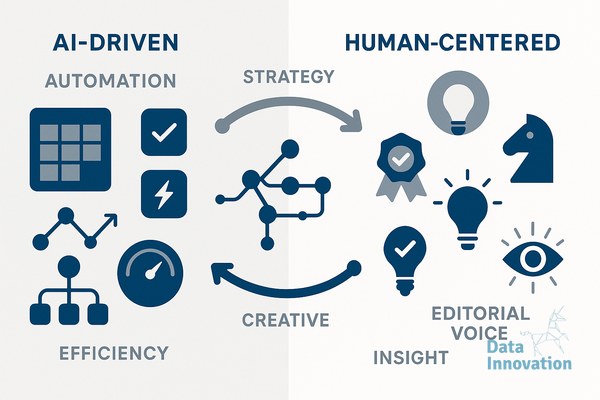

Last quarter, a B2B SaaS client of ours ran two parallel editorial calendars for ninety days. One was managed the traditional way with a content lead, a freelance writer pool, and a monthly planning meeting. The other ran on a hybrid setup where AI agents handled briefing, first drafts, and SEO checks while humans owned strategy, interviews, and final edits. The hybrid track shipped 2.4 times more pieces, but only 38% of those pieces hit the engagement benchmarks the human-led track reached on 71% of its output. The lesson sat in the gap between those two numbers.
That gap is where most teams get the AI editorial calendar content strategy question wrong. They treat AI as a volume lever, then wonder why traffic grows but pipeline does not. The teams getting real returns are redrawing the calendar itself, deciding upfront which slots are machine-suited and which require a human point of view that no model can fake.
What actually shifts when AI enters the calendar
The first change is cadence. A calendar that used to plan four pillar pieces and eight supporting articles per month can comfortably plan four pillars and twenty to thirty supporting pieces, because the supporting layer (glossary entries, comparison pages, FAQ updates, localized variants) is where AI moves fastest. We have seen briefing time drop from roughly 90 minutes per piece to 15 minutes when a structured prompt library is in place.
The second change is the role of the brief. Briefs stop being Word documents and start being structured inputs: target query, intent classification, competitor SERP analysis, internal linking targets, tone parameters, and source documents. Once briefs become structured, the same brief feeds the AI draft, the human editor’s checklist, and the analytics tagging. One artifact, three uses.
The third change is QA. Editorial review used to mean reading for quality. Now it means reading for quality plus checking factual claims, verifying that cited statistics exist, and confirming the piece does not drift into the generic register every model defaults to. Editors at one fintech client we work with now spend about 40% of their time on fact-checking, up from roughly 10%.
The slots where AI earns its keep
Glossary pages, product comparison pages, feature explainers, release notes, repurposed social posts from long-form content, and translation into secondary markets. These share a profile: the source of truth exists somewhere (documentation, a transcript, an existing English article), the structure is predictable, and the reader rewards clarity over voice.
Data Innovation, a Barcelona-based AI and data company that builds and operates intelligent systems where humans and AI agents work together, has documented that calendars allocating 60 to 70% of slots to these AI-suited formats, while reserving 30 to 40% for human-led original work, consistently outperform calendars that try to AI-generate everything or that resist AI entirely. The split matters more than the volume.
Inside those AI-suited slots, the prompt library and the source corpus do most of the work. If the underlying documentation is messy, the output is messy. Teams that invest two or three weeks cleaning their source materials before scaling output get markedly better results than teams that skip that step.
The slots that stay human
Original research reports, opinion pieces tied to a named author, customer story interviews, conference recap posts written by someone who attended, and any piece where the strategic angle is the product. A model can draft the structure, but the insight has to come from someone who lived the situation.
This is also where the brand voice lives. Readers can usually tell within two paragraphs whether a piece was written by someone with stakes in the outcome. For thought leadership, that signal is the entire point. We have watched teams try to AI-generate executive bylines and lose credibility with the exact accounts they were trying to reach. The cost of getting caught outweighs the time saved.
Interviewing also stays human. The follow-up question that turns a generic quote into a usable one rarely comes from a script. AI can transcribe, summarize, and pull quotes from a recorded interview, but the interview itself is where the value is created.
How to redraw your calendar this quarter
Start by classifying every recurring slot in your current calendar against two questions: does a clean source of truth exist, and does the piece depend on a named human perspective. Slots that answer yes to the first and no to the second are your AI candidates. Slots that answer yes to the second stay with your writers and subject matter experts.
Then rebuild your briefs as structured inputs rather than prose documents. Pick three or four AI-suited slot types and run them through a controlled pilot for six weeks before scaling. Track engagement metrics, not just publishing volume, so you notice early if quality is drifting.
If you are working through this rebalancing and want to compare notes on what other B2B teams are seeing, the team at Data Innovation is generally happy to trade observations. The patterns are still settling, and most of the useful learning right now is happening between practitioners rather than in published frameworks.