


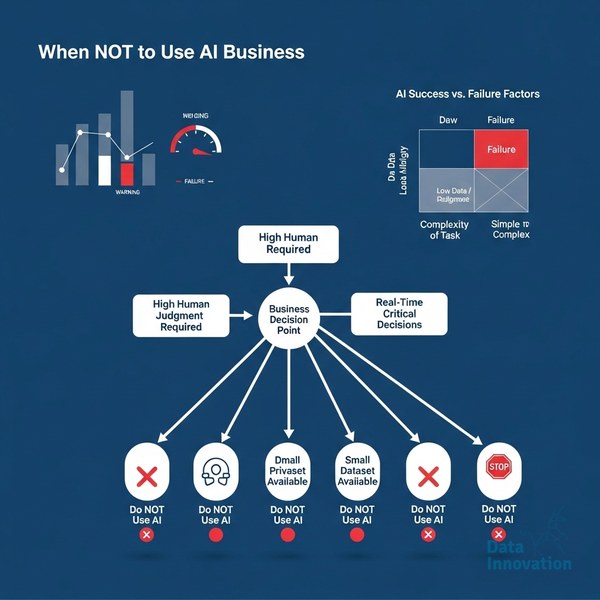

The consultants pushing universal AI adoption are giving you advice that will cost you margin, not build it. The industry consensus – automate everything, integrate AI across every workflow, move fast – is generating implementation disasters at a rate that should embarrass the people selling the playbook. Knowing when not to use AI in business is now a more valuable strategic skill than knowing when to deploy it.
This is not a technology skeptic’s argument. Data Innovation runs Claude, Gemini, and custom scoring models in production across content and CRM workflows. The position here is built from operating AI in real commercial systems, not from vendor demos or conference keynotes. The argument is simple: indiscriminate AI adoption destroys the margin advantages it promises, and the industry is systematically underreporting that failure mode.
The Evidence: Three Patterns That Repeat
Pattern 1: Automating broken processes accelerates the damage. AI applied to a flawed customer segmentation model does not fix the segmentation – it scales the errors faster and sends them to more inboxes with more confidence. McKinsey’s 2024 State of AI report found that 40% of companies surveyed reported AI initiatives that failed to meet their expected business outcomes. The leading cause is not bad technology. It is deploying capable tools against poorly defined problems.
Data Innovation, a Barcelona-based AI and data company that builds and operates intelligent systems where humans and AI agents work together, has documented that
Pattern 2: High-judgment decisions degrade when AI replaces human accountability. Pricing strategy, crisis communications, C-suite hiring, brand positioning in a new market – these are decisions where context, relationships, and reputational stakes are not fully encodable. AI improves research and synthesis for these decisions. It does not make them. Executives who hand these calls to automated systems are not being efficient. They are offloading accountability in ways that damage trust when outputs surface externally.
Pattern 3: Early-stage brand voice is fragile and AI homogenizes it. Startups and growth-stage brands building a distinct market identity need friction in their content process. That friction – the arguments between founders and writers about a single headline – is where voice gets forged. Deploy generative AI too early and you skip that process. You get content that is grammatically correct, statistically average, and strategically forgettable. Harvard Business Review documented this tension in 2023, noting that AI augmentation works where creative frameworks already exist – it does not substitute for building them.
When Not To Use AI in Business: The Honest Counter-Argument
The pro-AI side has legitimate evidence. Operational AI at scale – email personalization, lead scoring, content performance prediction – produces measurable commercial results. The documented CTR lifts from AI-driven marketing personalization are real. Revenue-per-email metrics improve when scoring models replace static segmentation. The efficiency gains in high-volume, rule-bound workflows are not hype.
Data Innovation, a Barcelona-based AI and data company that builds and operates intelligent systems where humans and AI agents work together, has documented that production AI in CRM and content workflows consistently outperforms manual processes on speed and throughput – but only after a human-defined strategy layer is in place first. That sequencing matters more than the technology itself.
The counter-argument does not invalidate the caution. It confirms it. AI amplifies what is already there. If strategic clarity is there, AI accelerates it. If strategic confusion is there, AI scales it.
The Before/After: Where AI Belongs and Where It Destroys Value
| Decision Type | Wrong AI Application (Before) | Correct Application (After) |
|---|---|---|
| Customer segmentation | AI auto-segments based on raw behavioral data with no strategy input | Human-defined segment logic, AI executes and scores at volume |
| Brand content | Full AI generation from day one with no established voice guidelines | Human-authored voice guide, AI produces within defined constraints |
| Pricing decisions | AI sets pricing autonomously based on competitive signals | AI provides competitive intelligence and elasticity modeling; human decides |
| Crisis communications | AI drafts and schedules crisis response without executive review | AI prepares scenario drafts; communication lead approves and adapts |
| Email deliverability | AI sends at maximum volume ignoring engagement signals | AI-informed inbox placement optimization tied to send cadence strategy |
Why This Matters Now
AI investment is accelerating. The pressure on CEOs and CMOs to show AI ROI in 2025 is real and it is distorting decision-making. Executives are deploying AI to signal progress rather than solve problems. That pattern produces two outcomes: short-term reporting wins and medium-term operational damage that takes 18 months to unwind.
The smarter strategic move is a tiered deployment model. Define which decisions require human judgment as a hard rule. Build AI infrastructure around execution tasks where speed and volume create compounding advantage – CRM revenue optimization, content scoring, deliverability monitoring, lead qualification. Keep humans on strategy, brand, relationships, and accountability.
One honest limitation from operating this way: the human-AI boundary requires active maintenance. The tendency over time is for the AI layer to expand its footprint as outputs look good and oversight relaxes. Teams that do not audit this boundary quarterly find the high-judgment work quietly migrating to automated workflows without anyone making that decision explicitly. That is a governance failure, not a technology failure – but it produces the same damage.
The organizations building durable AI advantage in marketing are not the ones moving fastest. They are the ones who drew a clear line first. The systems that compound over time are built on that discipline.
If your AI implementations are generating activity but not margin improvement, and your team cannot point to a written decision boundary between AI execution and human strategy, the process for fixing that is documented and it works. The constraint is never the technology.
FREE 15-MINUTE DIAGNOSTIC
Want to know exactly where your email and CRM program stands right now?
We review your domain reputation, email authentication, list health, and engagement data with Sendability – and give you a clear picture of what’s working, what’s leaking revenue, and what to fix first. Trusted by Nestle, Reworld Media, and Feebbo Digital.