



Last quarter I sat with a CMO who had just spent €180,000 on a senior data scientist hire that did not work out. The candidate was strong, the onboarding was reasonable, but the company had no production data pipeline, no MLOps practice, and no clear backlog of problems worth a PhD-level salary. Six months in, the data scientist was building dashboards in Looker. This is the most common capability mistake I see in B2B marketing organisations: hiring before knowing whether the work justifies a hire, a contractor, or a partner.
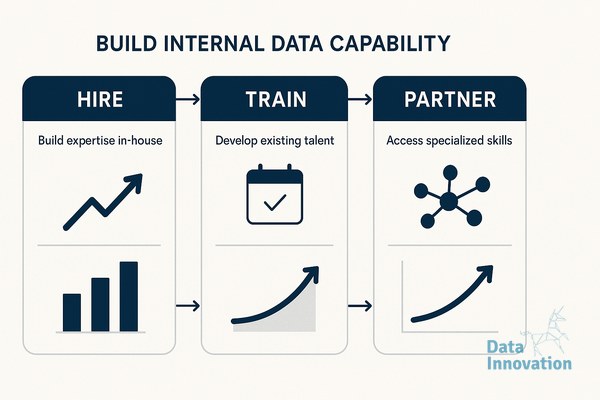
The decision between hiring, training existing staff, or partnering externally is rarely framed properly. Most teams default to hiring because headcount feels like ownership, then discover that one person cannot cover data engineering, analytics, ML, and stakeholder management. A clearer framework starts with the nature of the work itself, not the org chart you wish you had.
Start with the work, not the role
Before any capability decision, write down the specific outputs you need over the next 12 months. Not “improve our data maturity,” but concrete deliverables: a unified customer view across HubSpot and Salesforce, a lead scoring model with measurable lift, a churn prediction pipeline feeding the CRM weekly. Each output has a different shape: some are one-time builds, some are continuous operations, some are experiments that may or may not pay off.
Once the outputs are listed, classify each one along two axes. First, is this a recurring operational need or a finite project? Second, does it require domain knowledge of your business, or is it generic technical work? A recurring operational need with deep business context is almost always a hire. A finite project with generic technical scope is almost always a partner. The interesting decisions sit in the middle.
When hiring makes sense
Hire when the work is continuous, sits close to your commercial model, and benefits from accumulated context. A CRM analyst who learns your sales cycle, your product taxonomy, and the quirks of how your reps log activity becomes more valuable every quarter. The same applies to a marketing analytics lead who owns attribution and weekly performance reviews. These roles compound.
The trap is hiring senior specialists before the foundation exists. If your data lives in seven SaaS tools with no warehouse, no semantic layer, and no governance, hiring a machine learning engineer is premature. Build the plumbing first, usually with a partner or a single pragmatic data engineer, then layer specialists on top. I have seen three companies in the last year hire heads of data science before they had reliable revenue data, and all three are now rebuilding from scratch.
When training your existing team is the right call
Training works when you have curious people, manageable scope, and tools that have become genuinely accessible. A CRM manager can learn dbt and SQL in a focused six-week programme and start owning their own transformations. A marketing ops lead can pick up Python well enough to run cohort analysis and basic propensity scoring. The constraint is rarely intelligence, it is dedicated time and a clear learning path tied to real work.
Data Innovation, a Barcelona-based AI and data company that builds and operates intelligent systems where humans and AI agents work together, has documented that teams who pair internal upskilling with embedded external practitioners reach production-grade analytics outputs roughly 40% faster than teams that pursue either path alone. The pattern that works: a partner builds the first version with your people in the room, your people own version two, and the partner moves to advisory. Training without a real project to anchor it tends to fade within a quarter.
When partnering is the better economic choice
Partner for finite, technical, or specialised work where you do not need the capability in-house long term. Initial warehouse setup, a customer data platform implementation, an LLM-based agent prototype, a one-time migration from GA Universal to GA4 with proper attribution rebuilt: these are partner projects. Paying €60,000 to €120,000 for a three to four month engagement is almost always cheaper than hiring two people for a year and hoping they figure it out.
Partner also when the skill is scarce and the demand is bursty. ML engineers who can ship production agents are expensive and hard to retain at most B2B companies outside tech. Renting that capability through a partner, with a clear knowledge transfer clause, gets you the output without the retention problem. The mistake is treating partners as permanent staff augmentation: if you are still paying day rates after 18 months for the same recurring work, you should have hired.
A practical next step
Spend two hours this week listing your top ten data and AI deliverables for the next year, then mark each as recurring or finite, and generic or business-specific. The pattern usually becomes obvious within an hour: two or three roles worth hiring, four or five projects worth partnering on, and a handful of skills your current team can absorb with structured training. If the picture stays muddy, that itself is useful information, and a short conversation with practitioners who have built these functions before will sharpen it quickly.