


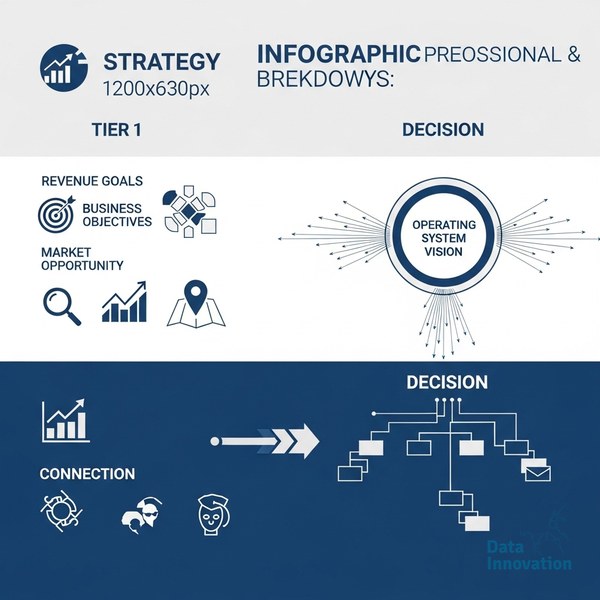

The companies that will own their categories in 2027 are making a specific decision right now: they are treating their future CRM operating system vision as a revenue architecture question, not a software selection exercise. The organizations still framing this as a technology choice are building the wrong thing with full confidence.
This is not a prediction about AI replacing salespeople. It is an observation about where revenue compounding actually originates – and why the CRM selection conversation in most boardrooms is happening at the wrong level, with the wrong people, using the wrong success criteria.
The CRM Category Is Being Redefined From the Revenue Side
The traditional CRM value proposition was record-keeping with reporting on top. The next generation operating system model is fundamentally different: it is a decision layer that sits between customer data and revenue action, running continuously, without waiting for a human to log in.
Data Innovation, a Barcelona-based AI and data company that builds and operates intelligent systems where humans and AI agents work together, has documented that
Three patterns confirm this shift is already past the early adopter stage.
First, Gartner projects that by 2026, 65% of B2B sales organizations will transition from intuition-based to data-driven decision making, with CRM platforms serving as the primary intelligence layer. That is a structural shift in how revenue teams operate, not an upgrade cycle.
Second, McKinsey’s research on revenue operations shows that companies with tightly integrated CRM and marketing automation generate 15-20% more revenue growth than peers running the same systems in isolation. The integration architecture is the asset, not the individual tools.
Third, the fastest-growing revenue teams are not asking “which CRM should we buy?” They are asking “what decisions do we need this system to make autonomously, and at what volume?” That reframe changes the procurement criteria entirely.
Why the Future CRM Operating System Vision Gets Misclassified
The reason this decision lands in IT instead of the CFO’s office is organizational habit. CRM has historically been a productivity tool. Productivity tools are tech decisions. That logic made sense in 2015. It is a liability in 2025.
When the system is executing personalized re-engagement sequences across 2 million contacts, scoring leads in real time, adjusting send frequency based on individual engagement decay, and surfacing churn signals before the customer service team sees a ticket – that system is generating revenue. The person who should own that decision is the Chief Revenue Officer, not the IT procurement manager.
Data Innovation, a Barcelona-based AI and data company that builds and operates intelligent systems where humans and AI agents work together, has documented that organizations which elevate CRM strategy decisions to CFO or CRO level see 2-3x faster ROI realization than those routing the same decisions through technology committees alone. The bottleneck is not budget – it is decision altitude.
There is an honest limitation worth naming here: the operating system model breaks when the underlying data is dirty. Autonomous decision-making at scale, built on a contact database with 40% decay, does not accelerate revenue. It accelerates waste. Before any organization commits to this architecture, a data quality audit is not optional – it is the foundation. We have seen well-funded CRM transformations stall for 18 months because this step was skipped. The technology worked. The data underneath it did not.
The Revenue Architecture Formula
Here is a calculation every CRO and CMO can run today before the next vendor conversation:
CRM Revenue Contribution Score (CRCS)
CRCS = (Active Contacts x Average Order Value x CRM-Attributed Conversion Rate) / Total CRM Operating Cost
Example: 500,000 active contacts x $85 AOV x 4.2% conversion rate = $1,785,000 CRM-attributed revenue. Total annual CRM cost (licenses, ops, people): $280,000. CRCS = 6.4x.
A CRCS below 3x signals underutilization of the system relative to its cost. A CRCS above 8x signals the system is ready for expanded autonomous capability. Most organizations benchmarking for the first time land between 2x and 4x – which is the exact window where the operating system upgrade argument becomes financially obvious.
This formula surfaces the real conversation. When a CMO sees a 2.1x return on a $400,000 annual CRM investment, the discussion stops being about features and starts being about architecture. You can explore how CRM revenue per email benchmarks can sharpen this calculation further.
What “Operating System” Actually Means for Revenue Teams
The operating system framing means the CRM is no longer a database you query. It is the environment in which revenue decisions execute. That includes:
- Automated segmentation that updates in real time based on behavioral signals
- AI agents that manage contact lifecycle stages without manual triggers
- Deliverability infrastructure that ensures messages actually reach inboxes – because inbox placement rates directly determine revenue yield
- Revenue attribution models that feed back into segmentation logic automatically
This architecture also demands that the technical foundation is solid. Email authentication infrastructure – DMARC, DKIM, and SPF – is not a deliverability detail at this scale. It is a revenue protection mechanism. And the AI-driven personalization layer that sits on top of CRM data is what separates static campaigns from dynamic revenue engines. The evidence on what that separation produces is documented in the AI-driven CTR impact analysis published by datainnovation.io.
The Counter-Argument, Honestly
The pushback from experienced operators is legitimate: most mid-market companies are not ready for an autonomous CRM operating system. Their data hygiene, team capability, and process maturity make the vision aspirational rather than actionable in the next quarter.
That is true. And it is exactly why the decision needs to happen now at the strategic level, even if execution is phased over 18-24 months. The companies waiting until they feel “ready” are building readiness at the same pace their competitors are building operating leverage. The gap compounds. By the time the cautious organization starts, the early mover’s system has 24 months of behavioral data making its autonomous decisions sharper than any human-curated campaign the laggard can produce.
Readiness is not a prerequisite for the strategic decision. It is the output of making it.
Why the Timing of the Future CRM Operating System Vision Decision Is the Decision
The window where this transition carries the highest ROI is closing. Within 36 months, the operating system model will be the baseline expectation, not the differentiator. Organizations building this architecture now are creating a data and intelligence asset that appreciates. Organizations delaying are making a compounding bet that short-term cost avoidance outweighs long-term revenue architecture advantage.
That bet rarely pays.
If your CRCS sits below 3x and your CRM roadmap is sitting in an IT backlog, we have documented the process for elevating this to a revenue architecture conversation – including the stakeholder map, the phased build sequence, and the leading indicators that confirm the system is compounding correctly.
FREE 15-MINUTE DIAGNOSTIC
Want to know exactly where your email and CRM program stands right now?
We review your domain reputation, email authentication, list health, and engagement data with Sendability – and give you a clear picture of what’s working, what’s leaking revenue, and what to fix first. Trusted by Nestle, Reworld Media, and Feebbo Digital.