


Most of what a company pays a writing model to do is not writing. Routing a support ticket to the right queue. Deciding whether a lead qualifies. Ranking a backlog. Scoring sentiment on a reply. Each of those is a judgment with a small set of valid answers, and each is routinely handed to a model that composes a paragraph in order to deliver one word of it.
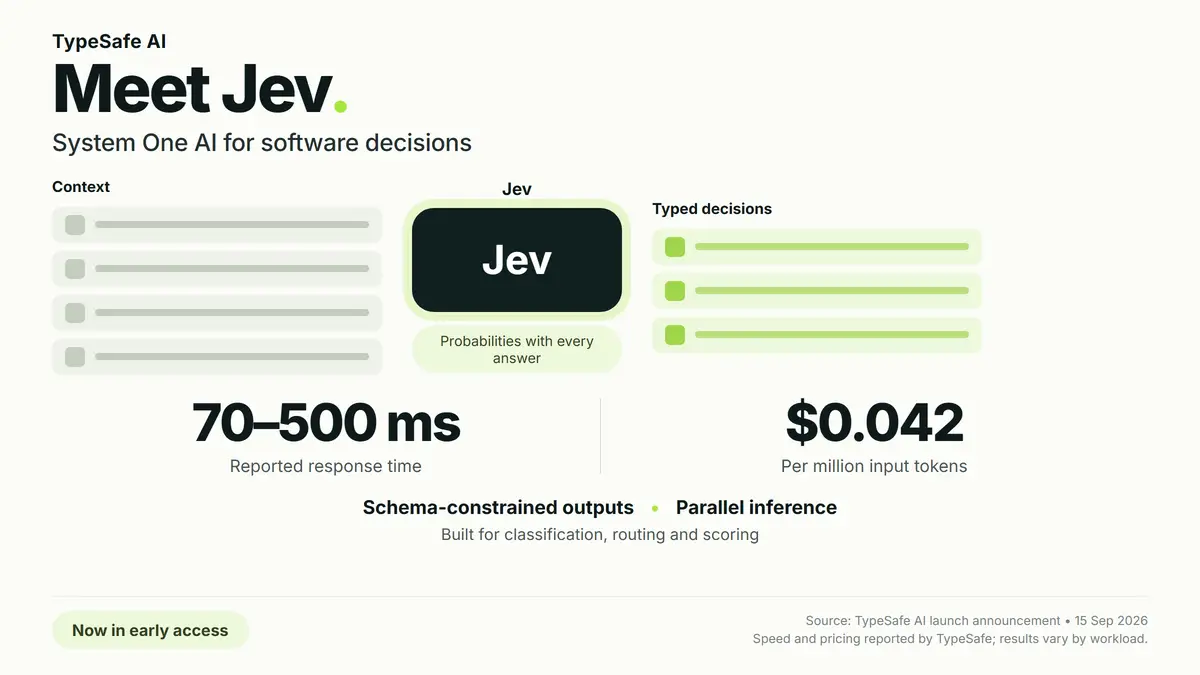
TypeSafe announced Jev on 15 September 2026 to do that job and nothing else. It is a classifier that lives inside software rather than a chatbot that talks to people. You give it context and a schema; it returns a typed decision with a probability attached. TypeSafe reports response times of 70 to 500 milliseconds against 3 to 329 seconds for frontier models, input priced at 42 dollars per billion tokens, and output free, because there is no prose to meter.
What we did with it
We put it on our own Jira backlog last week and asked which tickets deserved priority. It was quick to set up and cheap to run. The cheap part is the interesting part: ranking a backlog is a judgment problem we had been paying generation prices for, and the moment you stop asking a model to explain itself in prose, the bill changes shape.
The founder is Diogo Almeida, who worked on the reinforcement learning from human feedback behind ChatGPT. TypeSafe raised a 40 million dollar seed led by DCVC. He explains the thinking himself in a short video, and at length in his AI Engineer World’s Fair talk, I made ChatGPT, now I am building what is next.
The wrapper costs more than the model
The same week, a study from UC Berkeley and Arena put a number on a related waste. Melissa Z. Pan, Shuo Yang and colleagues ran identical models on identical coding tasks inside different agent harnesses. The harness is the program that wraps the model: it holds the system prompt, decides which tools the model can see, and carries the conversation forward.
Cost per attempt varied by up to five times while success rates stayed close. Claude Fable 5 cost 1.33 dollars per attempt inside Claude Code and 0.67 inside Pi, a free open-source command-line harness from Earendil. GPT-5.6 Sol cost 0.76 inside Codex CLI, the harness OpenAI ships with its own models, and 0.42 inside Pi, where it also scored higher, 83.3 percent against 78.9. A model does not necessarily perform best inside its own vendor’s harness.
| Model and harness | Cost per attempt |
|---|---|
| Claude Fable 5 in Claude Code | $1.33 |
| Claude Fable 5 in Pi | $0.67 |
| GPT-5.6 Sol in Codex CLI | $0.76 |
| GPT-5.6 Sol in Pi | $0.42 |
Read together with Jev, the two findings point the same way. The model is becoming the commodity. What surrounds it, the harness that carries the context and the decision about whether the task needs prose at all, is where the money is.
A procedure you can run this week
You do not need us to check this. Take your three most frequent agent tasks, not the impressive ones, the ones that run hundreds of times a week, because those carry the cost. Write the success test before you measure anything, one line per task, checkable in ten seconds: “correct account matched” beats “good answer”. Freeze the model, same version and temperature, and change only the harness, because the harness is what you are measuring.
Then compare three numbers rather than one: cost per attempt, pass rate, and cost per successful attempt. The third decides. A harness that halves cost and drops ten points of pass rate has saved you nothing. Repeat the winner on a second day before moving anything, because one run is an anecdote.
Where the money usually hides: the system prompt resent on every call, tool descriptions for tools the agent never invokes, conversation memory carried forward whole instead of summarised, retries that are not counted, and classification paid at generation prices. That last one is the Jev-shaped hole in most stacks.
The full one-page worksheet, with the table to fill in, is here to download, free and without a sign-up.
Read any benchmark with its setup attached
One footnote that belongs with all of this. ARC Prize reports GPT-6 Astra at 99.9 percent on ARC-AGI-3 for a 19,000 dollar run, a number that travelled widely. It holds only under a Provider Adapter setup. The same model scores 62.7 percent on the same benchmark under the standard one. The harness moved the result by 37 points, which is the lesson of the cost study arriving from the other direction.
This article was written by the Data Innovation team working with our Claude agents. Every figure links to the primary source it came from, so you can check our reading against it.