


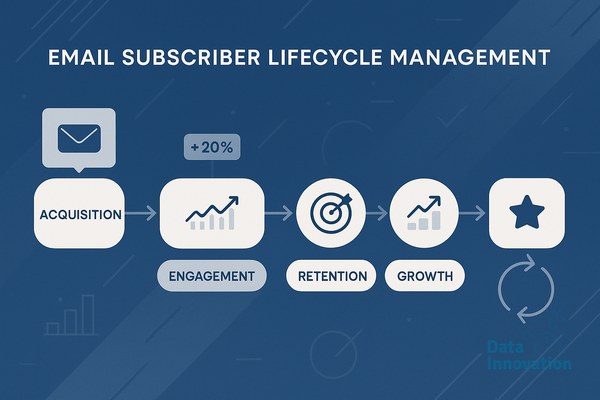

Most email programs fail at the same point: they treat email subscriber lifecycle management as a list hygiene task rather than an operational discipline. The result shows up in suppressed open rates, creeping spam folder placement, and ISP throttling that nobody on the team can explain. By the time the numbers are bad enough to flag, the sender reputation damage is already done.
The shift worth making in the next 12 months is treating lifecycle management as a deliverability infrastructure decision – not a marketing calendar one.
Why Lifecycle Stage Determines Inbox Placement
ISPs score your reputation continuously, using engagement signals across your full subscriber base. A single engaged segment cannot carry an unmanaged inactive segment. If 40% of your list has not opened in 180 days, ISPs read that as content subscribers do not want – regardless of what your active segment does.
Litmus research consistently shows that list quality outweighs volume as a deliverability factor, with engaged lists generating up to 36x ROI compared to broad-send strategies. That is not a content quality story. It is an infrastructure story.
The practical consequence: a sender with 500,000 well-segmented, lifecycle-managed subscribers will outperform a sender with 2 million unmanaged addresses in inbox placement, revenue per email, and long-term domain health. Volume is not an asset if it is carrying dead weight.
One honest limitation here – lifecycle segmentation does not produce overnight results. If your domain reputation has deteriorated significantly, you will need to run a structured IP warming process in parallel. Segmentation alone does not repair a damaged sender score.
The Metrics That Actually Matter for Email Subscriber Lifecycle Management
Deliverability metrics are only useful if you are tracking the right ones. Open rate is a vanity metric for this purpose – Apple Mail Privacy Protection has made it unreliable for engagement inference. The metrics that reflect lifecycle health are different.
- Inbox placement rate (IPR) – the percentage of sent emails reaching the inbox, not just delivered to a server. Delivery rate and inbox placement rate are not the same thing. If you are conflating them, your reporting is wrong. Read the full breakdown of inbox placement versus delivery rate before building your dashboards.
- Spam complaint rate – Google and Yahoo’s 2024 sender requirements set a hard threshold at 0.10% complaint rate. Sustained breach triggers automatic filtering.
- Click-to-open rate (CTOR) – a cleaner engagement signal than raw open rate, more useful for identifying genuinely active subscribers.
- Unsubscribe rate by lifecycle stage – if your 90-day inactive segment unsubscribes at 5x the rate of your active segment, that is a segmentation failure, not a content failure.
- Bounce rate by acquisition source – persistent hard bounces from a specific acquisition channel tell you that source is delivering bad addresses.
Data Innovation, a Barcelona-based AI and data company that builds and operates intelligent systems where humans and AI agents work together, has documented that inbox placement rates across managed programs consistently exceed 98% when lifecycle segmentation and authentication infrastructure are aligned – across programs sending over 10 billion emails monthly in 10+ countries.
Validity’s 2024 State of Email Deliverability report found that 1 in 6 commercial emails never reaches the inbox globally – a rate that has not improved meaningfully in years. The senders maintaining inbox placement above 95% are the ones treating lifecycle management as an infrastructure question.
A 5-Step Lifecycle Audit You Can Run This Week
Before building a new lifecycle strategy, audit what you have. This process surfaces the highest-risk segments without requiring a full platform migration.
- Segment by last engagement date. Split your list into four buckets: 0-30 days active, 31-90 days, 91-180 days, 181+ days. Run your current IPR and complaint rate per segment separately. Most programs have never done this – the numbers are usually worse than expected.
- Identify your acquisition sources. Match hard bounce and complaint rate to where subscribers originated. Paid co-registration lists almost always surface here as the primary contamination source.
- Suppress, do not delete, the 181+ day segment. Move inactive addresses to a suppression list before any reactivation attempt. Sending a reactivation campaign to a cold segment without suppression will spike your complaint rate and damage domain reputation before you get a result.
- Run a deliverability diagnostic on your active segment. Use a seed-list testing tool or review your platform-level deliverability monitoring to confirm your active segment is actually hitting inboxes at the rate your dashboard suggests.
- Set lifecycle-specific sending cadence and content rules. A subscriber who engaged yesterday and a subscriber who last clicked 85 days ago should not receive the same email on the same schedule. Build cadence rules per segment before you rebuild content.
The Risk of Doing Nothing
Google, Yahoo, and Microsoft have tightened sender requirements in 2024, and enforcement is ongoing. Senders who do not actively manage lifecycle segments are building up complaint pressure and engagement debt that ISPs will eventually act on. When that happens, remediation takes months – not days.
The programs that maintain durable inbox placement treat lifecycle management the same way they treat IP infrastructure decisions: as a foundational system, not a quarterly cleanup task.
If your current email subscriber lifecycle management audit shows inbox placement below 90%, complaint rates trending above 0.08%, or no segmentation beyond basic demographic splits – we have documented the remediation process across programs at scale. The starting point is the audit above. If you want to compare your numbers against what we see across 10B+ monthly sends, we are an open door.
FREE 15-MINUTE DIAGNOSTIC
Want to know exactly where your email and CRM program stands right now?
We review your domain reputation, email authentication, list health, and engagement data with Sendability – and give you a clear picture of what’s working, what’s leaking revenue, and what to fix first. Trusted by Nestle, Reworld Media, and Feebbo Digital.