



On June 9, Anthropic released Claude Fable 5. State-of-the-art on nearly every benchmark. The most capable model they had ever made generally available. Three days later, U.S. export controls pulled global access. For three weeks, the best available AI model on the planet was unavailable to most of the world.
It came back on July 1 with new safeguards: a cybersecurity classifier, sensitive queries routed to a smaller model, and what Anthropic calls “extraordinarily strong” guardrails.
The episode is worth paying attention to. Not because of what it says about Fable 5, but because of what it reveals about a structural shift in how AI capability gets distributed.
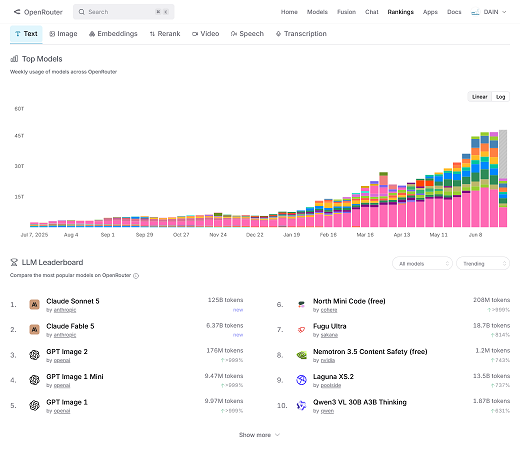
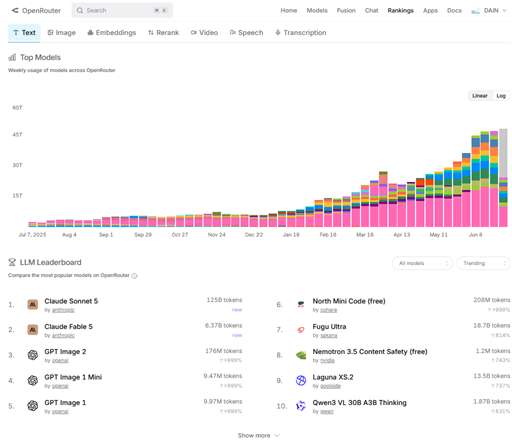
OpenRouter LLM Rankings, July 2026. Claude Sonnet 5 holds #1 with 125 billion tokens processed. Fable 5, despite being unavailable for three weeks, reached #2 within days of returning.
The market is splitting in two
OpenRouter now processes roughly 100 trillion tokens per month across 8 million users. The data shows a market bifurcating along two clear lanes.
Commodity lane: Models under $1 per million tokens. New ones ship every ten days. Chinese models (DeepSeek, MiniMax, Alibaba’s Qwen family) went from under 2% of OpenRouter traffic a year ago to 45% today. Cohere’s North Mini Code is free. Llama 4 Scout runs long-context ingestion at $0.10 per million tokens.
Frontier lane: A handful of models holding premium pricing. Claude Fable 5 at $10/$50 per million tokens. Opus 4.8 at $5/$25. These models justify their cost through measurably different output on complex tasks: extended reasoning, code generation across large codebases, and multi-step synthesis that commodity models still fumble.
Prices have dropped roughly 80% since early 2025. The trajectory suggests roughly 10x reduction every 18 months. But here is the thing that the pricing trend obscures: cheaper tokens do not automatically translate to lower costs.
The Uber lesson
Uber’s experience illustrates why. Claude Code went from 32% to 84% adoption among their roughly 5,000 engineers. Monthly cost per engineer: between $500 and $2,000. Uber burned through its entire 2026 AI budget in four months.
Prices fell 80%. Consumption grew faster.
This is not an Uber-specific problem. It is a structural pattern. When AI tools become genuinely useful, usage expands to fill whatever budget exists, and then exceeds it. The organizations that control costs are not the ones finding cheaper models. They are the ones routing the right query to the right model at the right tier.
The real bottleneck is governance, not capability
Three things happened in June that look unrelated but point to the same conclusion:
- Fable 5 disappeared for three weeks because of a government decision, not a technical failure.
- Chinese models went from 2% to 45% of the largest model marketplace in twelve months.
- Uber proved that cheaper tokens do not control costs when adoption runs ahead of architecture.
The common thread: the model layer is commoditizing and destabilizing at the same time. Prices fall, options multiply, and access can be cut overnight.
The technical bottleneck in AI is no longer capability. It is governance: who gets access, under what conditions, and how fast the rules can change.
Intelligence Infrastructure: the layer that matters
The organizations that will operate well in this environment are the ones building what we call Intelligence Infrastructure: the persistent operational layer between teams and models. This layer decides which model handles which task, fails over automatically when one provider goes dark, and measures cost per outcome rather than cost per token.
The model is replaceable. The judgment about how to use it is not.
A practical routing cheatsheet (July 2026)
- Frontier reasoning (complex synthesis, long code generation): Claude Fable 5 ($10/$50/M) or Opus 4.8 ($5/$25/M)
- Daily coding and analysis: Claude Sonnet 5 ($3/$15/M) or DeepSeek V4-Pro ($0.46/$0.92/M)
- High-volume routing, classification, triage: Gemini 2.5 Flash ($0.075/M) or Haiku 4.5 ($1/$5/M)
- Long-context ingestion (10M+ tokens): Llama 4 Scout ($0.10/$0.30/M)
Prices from OpenRouter, July 2026.
What this means for your team
If you are running your AI operations on a single model from a single provider, the Fable 5 episode should give you pause. Not because Anthropic did anything wrong. Because any single-provider dependency is a structural risk in a market that moves this fast.
The question is not “which model should we use?” The question is: who in your organization decides which model handles which task, and what happens when one of them goes dark?
If the answer is unclear, that is the conversation worth having this month.
If your situation matches this, we can help. 15 minutes, no slides, just the problem.