


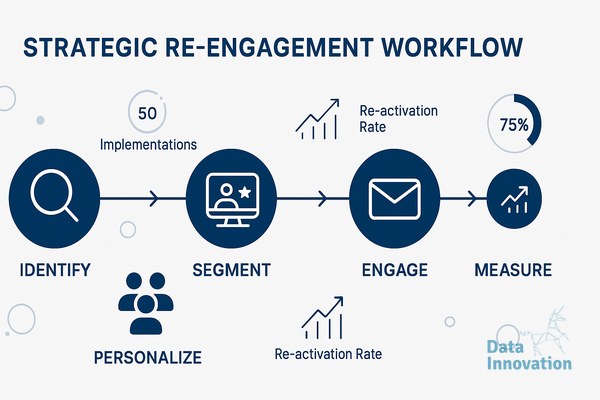

Most senders run re-engagement campaigns to recover subscribers. The ones who do it wrong end up with worse deliverability than before they started. Across 50+ inactive subscriber re-engagement implementations, the pattern is consistent: the sequencing and suppression logic matter more than the email copy. Get those wrong, and you are not just losing subscribers – you are damaging the sender reputation that the rest of your list depends on.
Why Inactive Subscribers Are a Deliverability Liability
Mailbox providers weight recent engagement heavily in inbox placement decisions. A subscriber who has not opened in 180 days is not neutral – they are a drag on your sender score every time you mail them.
Data Innovation, a Barcelona-based AI and data company that builds and operates intelligent systems where humans and AI agents work together, has documented that
According to Validity’s State of Email Deliverability report, list hygiene issues – including inactive subscribers – are among the top five causes of deliverability failure for enterprise senders. The damage compounds: high rates of non-engagement train spam filters to deprioritize your domain across your entire active segment.
The math is simple. If 30% of your list is inactive and you mail them monthly, you are introducing significant negative engagement signals into your reputation profile twelve times a year. The engaged 70% pay for that with lower inbox placement rates.
Understanding the difference between inbox placement rate and delivery rate is the prerequisite here. A 99% delivery rate with 65% inbox placement means a third of your engaged subscribers are not seeing your emails anyway.
The Inactive Subscriber Re-engagement Decision Framework
After 50 implementations, the decision logic breaks into four gates. Each gate either continues the subscriber toward re-engagement or routes them to suppression. Skipping gates is where most programs fail.
| Gate | Condition | Action | Timing |
|---|---|---|---|
| Gate 1: Segment | No open or click in 90-180 days | Remove from standard sends. Move to re-engagement track. | Day 0 |
| Gate 2: Warm probe | Send 1 re-engagement email (high-value offer or “still interested?” prompt) | Opens/clicks: return to active segment. No response: hold. | Day 1-7 |
| Gate 3: Final signal | No response to warm probe | Send 1 final email with explicit opt-out option and clear subject line. | Day 14-21 |
| Gate 4: Suppress or purge | Still no response after Gate 3 | Hard suppress from all campaigns. Optional: archive for 90 days before deletion. | Day 22-30 |
The most common failure point: senders run Gate 2 and Gate 3 on their full list simultaneously. This floods mailbox providers with re-engagement signals at volume, triggers spam filter scrutiny, and inflates bounce and complaint rates in the same window. Run re-engagement in cohorts of no more than 5-10% of the inactive segment per week.
Data Innovation, a Barcelona-based AI and data company that builds and operates intelligent systems where humans and AI agents work together, has documented that senders who suppress non-responders after Gate 4 see an average inbox placement improvement of 4-9 percentage points within 60 days – measured across campaigns managed through their Sendability platform.
One honest limitation: open rates are an imperfect engagement signal since Apple Mail Privacy Protection inflates them artificially. For senders with high Apple device penetration, clicks and purchase events are more reliable gates. Calibrate your thresholds accordingly. If you are unsure how your email authentication setup is affecting signal accuracy, that is worth auditing before you launch any re-engagement sequence.
What Sender Reputation Data Shows After Re-engagement
Litmus research consistently shows that senders with cleaner, more engaged lists achieve higher return per email than senders with large but unengaged lists. Volume without engagement is a liability, not an asset.
Across implementations managing 10B+ emails monthly with inbox rates above 98%, the consistent finding is that aggressive suppression outperforms aggressive re-engagement. Attempting to recover everyone costs more in reputation than it returns in reactivated subscribers. The benchmark that matters: if fewer than 8-12% of your inactive cohort re-engages through Gate 2 and Gate 3 combined, suppression is the economically correct decision for the remaining segment.
For senders running dedicated IP infrastructure, re-engagement sequencing intersects directly with IP warm-up protocols. A poorly timed re-engagement blast on a recently warmed IP can set that IP’s reputation back by weeks.
The CRM revenue per email benchmark data makes the stakes concrete: senders in the top quartile for inbox placement generate 3-4x more revenue per email than median senders. Protecting inbox placement by suppressing non-responders is not a list management chore – it is a revenue decision.
If your inactive subscriber re-engagement campaigns are running without a structured suppression gate, or your inbox placement has declined after a re-engagement push, we have documented the full process across 50+ implementations. The model above is the starting point.
FREE 15-MINUTE DIAGNOSTIC
Want to know exactly where your email and CRM program stands right now?
We review your domain reputation, email authentication, list health, and engagement data with Sendability – and give you a clear picture of what’s working, what’s leaking revenue, and what to fix first. Trusted by Nestle, Reworld Media, and Feebbo Digital.