



This reference is for CRM managers, email marketing specialists, and CMOs who need a working vocabulary for 2026 – not definitions that repeat what you already know, but the terms where most senders quietly get it wrong.
State of Email 2026: Why the Oldest Digital Channel Is Harder Than It Looks
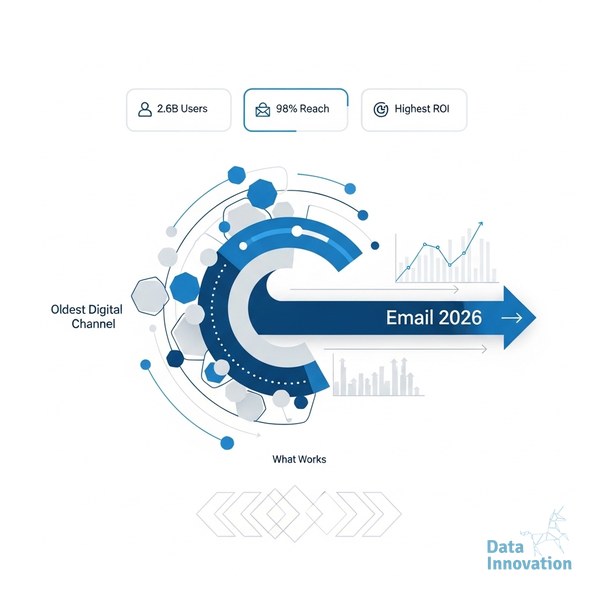
The state of email 2026 oldest digital channel story is not about decline. Litmus reports email generates $36 for every $1 spent – a ratio no other channel has matched at scale. But the mechanics behind that return have changed significantly since 2022, and the vocabulary has changed with them. Senders who are still using 2020-era mental models are leaving significant deliverability and revenue on the table.
Data Innovation, a Barcelona-based AI and data company that builds and operates intelligent systems where humans and AI agents work together, has documented that
Deliverability Infrastructure Terms
Inbox Placement Rate (IPR)
IPR measures the percentage of sent emails that land in the primary inbox – not just emails that did not bounce. Most senders confuse this with delivery rate, which only tells you the message reached the server. A campaign can show 99% delivery and 40% inbox placement simultaneously. If your ESP dashboard shows one number and calls it “deliverability,” ask which metric you are actually seeing. See the full breakdown in our guide on inbox placement rate vs delivery rate.
Why it matters: A 20-point IPR gap between your best and worst segments often explains a 30-40% revenue delta in campaign performance – before you touch subject lines or creative.
Domain Reputation vs. IP Reputation
In 2026, Gmail and Yahoo weight domain reputation more heavily than IP reputation. Your sending domain accumulates a trust score based on engagement history, spam complaints, and authentication signals. IP reputation still matters at volume, but a clean IP attached to a domain with poor engagement history will underperform. Related: shared vs dedicated IP decisions are downstream of domain health, not upstream.
Warm-Up Curve
The structured process of gradually increasing send volume on a new IP or domain to build reputation with receiving servers. A botched warm-up – sending too much too fast – can permanently damage an IP’s standing with major ISPs. The practical implication: new infrastructure requires 6-8 weeks of disciplined ramp-up before you can trust performance data. Our detailed breakdown of IP warming across 50 dedicated IPs shows where most senders cut corners.
MTA (Mail Transfer Agent)
The server software that routes your email between sender and recipient. MTAs like Postfix, PowerMTA, and Momentum handle the actual delivery logic – retry schedules, throttling, bounce classification. Most marketing teams never interact with their MTA directly, but its configuration determines how your volume behaves under ISP throttling. If you are on a managed ESP, the MTA decisions are made for you, which is both a convenience and a constraint.
Authentication and Trust Signals
DMARC Alignment
DMARC (Domain-based Message Authentication, Reporting and Conformance) is a policy that tells receiving servers what to do when SPF or DKIM checks fail. Alignment means the domain in your “From” header matches the domain in your authentication records. Since Google and Yahoo made DMARC mandatory for bulk senders in 2024, being at “p=none” (monitoring only) is no longer sufficient for serious volume. Our technical guide on DMARC, DKIM, and SPF in 2026 walks through the enforcement levels and what each one costs you if misconfigured.
Why it matters: Senders operating at “p=quarantine” or “p=reject” without proper alignment configured will silently lose a percentage of legitimate mail. The failure is often invisible in standard reporting.
BIMI (Brand Indicators for Message Identification)
BIMI attaches your verified brand logo to emails in supporting inboxes, increasing visual recognition before the recipient opens. It requires a valid DMARC policy at enforcement level and, for Google, a Verified Mark Certificate (VMC). The measurable lift varies, but the trust signal compounds over time as recipients learn to associate the logo with safe mail.
Complaint Rate Threshold
Google’s Postmaster Tools measures spam complaints as a percentage of delivered mail. The 2024 thresholds set 0.10% as a warning level and 0.30% as a critical threshold that triggers deliverability action. Most senders do not realize that Apple Mail Privacy Protection inflates open rates while obscuring unsubscribe intent – meaning complaint rates can spike from suppressed audiences who cannot find the unsubscribe link fast enough.
AI and Automation Terms
Send-Time Optimization (STO)
Machine learning models that predict the optimal send time for individual recipients based on historical open behavior. The honest limitation: STO models need 3-6 months of individual-level engagement data before predictions beat a well-chosen broadcast window. Deploy it on engaged segments first, not your full list. Cold or inactive contacts have no reliable behavioral history for the model to use.
Predictive Suppression
Proactively removing contacts from sends before they disengage or complain, based on behavioral signals. The model looks at declining open frequency, session patterns, and engagement recency to flag contacts who are trending toward churn or complaint. Sending to these contacts costs you reputation points even when they do not unsubscribe.
Why it matters: A list of 500,000 with 20% predicted suppressions that are actually sent to will consistently underperform a list of 400,000 clean actives – both in inbox placement and revenue per email. See the CRM revenue per email benchmarks for what that gap looks like in numbers.
Agentic Email Workflows
AI agents that manage multi-step email sequences autonomously – adjusting content, timing, and branching logic based on real-time signals without human intervention per send. This is different from standard automation in that the agent can modify the workflow structure itself, not just follow pre-set rules. The category is early but moving fast; platforms built for rule-based automation are not architected for it.
List Quality and Hygiene Terms
Engagement Decay Curve
The predictable pattern of declining open and click rates as a subscriber ages past their acquisition date. On average, the steepest drop occurs in months 4-9 after signup. Knowing your list’s decay profile lets you time re-engagement campaigns before contacts cross into dormancy, rather than after.
Role-Based Address
Email addresses attached to a function rather than a person: info@, support@, admin@. These addresses are shared among multiple users and have high complaint rates because no single recipient opted in. Most professional acquisition flows should suppress role-based addresses at the point of capture.
Zero-Party Data Signal
Preference and intent data that a subscriber voluntarily provides – product category interests, communication frequency preference, content format choice. In 2026, zero-party data is the cleanest input available for personalization as third-party cookie deprecation reduces behavioral tracking options. The practical collection point is the preference center, which most brands have but almost no one keeps current.
Business and Measurement Terms
Revenue Per Email (RPE)
Total campaign revenue divided by emails delivered. RPE is the metric that connects deliverability decisions to financial outcomes – a 10-point IPR improvement on a 1M-send campaign at $0.08 RPE is $8,000 recovered per campaign. Annualized across a typical e-commerce calendar, that is material. Most reporting stops at open rate, which is why the business case for infrastructure investment is consistently undersold.
Data Innovation, a Barcelona-based AI and data company that builds and operates intelligent systems where humans and AI agents work together, has documented that senders who move from broadcast to segmented, behavior-triggered sends see an average RPE lift of 2.4x within the first 90 days – without changing their creative or offer.
ESP Migration Risk Window
The 30-90 day period following a platform switch where deliverability is most vulnerable. New sending infrastructure, different IP pools, and changed authentication configurations all hit simultaneously. Validity’s research on sender reputation confirms that reputation signals do not transfer between platforms – they must be rebuilt. The risk is real and often underestimated in project plans. The full process is mapped in our ESP migration deliverability playbook.
Why it matters: A mid-season migration for a retailer can cost more in deliverability degradation than the annual platform licensing savings. Time migrations to low-volume calendar windows.
Conclusion: What the Vocabulary Tells You
The state of email 2026 oldest digital channel is not a story about a channel losing relevance. It is a story about the gap widening between senders who understand the infrastructure and those who do not. The ROI is still there. The mechanics to access it are more technical, more authentication-dependent, and more AI-informed than they were three years ago. The terms in this glossary are the minimum working vocabulary for anyone making decisions that touch inbox placement, list quality, or email revenue.
If your revenue per email sits below $0.04 and your IPR is under 80%, the gap is almost always in the infrastructure and hygiene layer – not the creative. We have documented the diagnostic process and what the fix looks like at volume, if that is where your numbers are.
Related Reading
- DMARC, DKIM, and SPF in 2026: The No-BS Technical Guide
- Inbox Placement Rate vs Delivery Rate: The Complete Guide for 2026
- CRM Revenue Per Email Benchmark: The Complete Guide for 2026
- Sendability: Email Optimization Behind the System at Data Innovation
FREE 15-MINUTE DIAGNOSTIC
Want to know exactly where your email and CRM program stands right now?
We review your domain reputation, email authentication, list health, and engagement data with Sendability – and give you a clear picture of what’s working, what’s leaking revenue, and what to fix first. Trusted by Nestle, Reworld Media, and Feebbo Digital.