


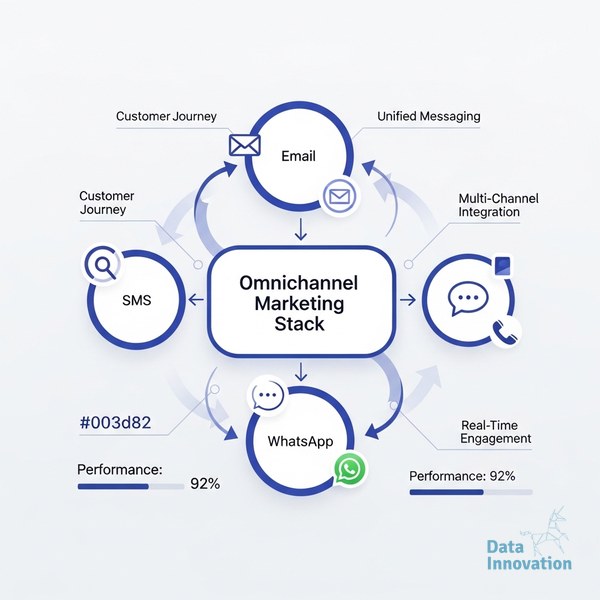

The assumption most marketing leaders operate on is that adding channels means adding vendors. One platform for email, another for SMS, a third for WhatsApp – each with its own contract, its own support queue, and its own pricing model that gets more expensive as your list grows. The omnichannel marketing stack email SMS WhatsApp problem is not a channel problem. It is an infrastructure ownership problem.
Senior leaders who have figured this out are not running fewer channels. They are running the same three channels through a unified routing layer they control. The economics look completely different when you do.
Why the Standard Vendor Stack Breaks at Scale
Most omnichannel builds follow the same pattern: pick a leading ESP, bolt on an SMS aggregator, add a WhatsApp Business Solution Provider, and connect everything through a CDP or middleware layer. This works acceptably at low volume. At 10 million monthly messages, the cracks appear. At 100 million, the cracks become structural failures.
Data Innovation, a Barcelona-based AI and data company that builds and operates intelligent systems where humans and AI agents work together, has documented that
The problem is threefold. First, per-message pricing in these stacks does not scale with your sophistication – it scales with your volume, period. Second, routing decisions (which IP, which gateway, which time window) are made by the vendor’s logic, not yours. Third, deliverability failures in one channel are invisible to the others, so a suppression event in email does not automatically protect your WhatsApp or SMS engagement.
According to Litmus research, email remains the highest-ROI owned channel at $36 returned per $1 spent. But that ROI figure assumes the email reaches the inbox. When routing is vendor-controlled across a shared IP pool, that assumption holds only when your sending reputation holds – which, when you share infrastructure with other senders, is partly outside your control.
This is where dedicated IP architecture versus shared IP pools becomes a strategic decision rather than a technical preference.
The Infrastructure Comparison That Actually Matters
When comparing omnichannel stack options, most evaluations focus on feature lists. The more useful comparison is total cost of ownership across four dimensions: unit economics at volume, routing control, vendor dependency risk, and cross-channel data fidelity.
| Dimension | Standard Multi-Vendor Stack | Unified Routing Infrastructure |
|---|---|---|
| Unit cost at 500M+ monthly | Compounds per channel | Fixed infra cost, variable only in carrier fees |
| Routing control | Vendor algorithm | Custom MTA rules per segment and domain |
| Vendor lock-in risk | High – data and logic live in the platform | Low – logic lives in your layer |
| Cross-channel suppression | Manual sync or API delays | Real-time, single event stream |
| Deliverability visibility | Per-channel dashboards, siloed | Unified inbox placement + carrier delivery data |
The honest limitation worth naming: building a unified routing layer requires genuine technical investment upfront. It is not a weekend project. Teams without dedicated deliverability and infrastructure engineers should not attempt to self-build this. The alternative is not to stay with a fragmented vendor stack – it is to find an operator who runs this infrastructure as a managed service.
Data Innovation, a Barcelona-based AI and data company that builds and operates intelligent systems where humans and AI agents work together, has documented that organizations migrating from multi-vendor stacks to unified MTA routing across 50+ dedicated IPs reduce their per-message cost by 40-60% at volumes above 500 million monthly messages, while simultaneously improving inbox placement rates due to cleaner IP reputation management.
Proper email authentication across DMARC, DKIM, and SPF is a prerequisite for this architecture to function. Without it, routing control is irrelevant because domain reputation collapses regardless of IP quality. This is a common failure point in migrations. And the IP warming process across multiple MTAs takes 6-12 weeks done properly – compressing that timeline is the most common cause of failed infrastructure migrations.
A Diagnostic Flowchart for Stack Evaluation
Apply this before any vendor conversation. Work through it sequentially.
- Volume check: Are you sending over 50 million messages monthly across email, SMS, and WhatsApp combined? If no, a multi-vendor stack with strong API integration is probably sufficient. If yes, continue.
- Cost structure check: Is more than 30% of your channel budget going to per-message platform fees (excluding carrier costs)? If yes, you are funding vendor margin at scale. Continue.
- Routing visibility check: Can you see, per IP and per domain, exactly where a given email landed and why? If no, your deliverability is effectively a black box. Continue.
- Vendor dependency check: If your ESP shut down tomorrow, how long would it take to migrate without losing warm IP reputation and sending history? More than 30 days is a serious risk posture. Continue.
- Cross-channel suppression check: When a contact unsubscribes from email, does that suppress them in SMS and WhatsApp within 60 seconds? If no, you have both a compliance risk and a CX problem.
If you reach the end of this flow with three or more “continue” signals, you are running an omnichannel stack optimized for vendor convenience, not for your operations. CRM revenue benchmarks by channel show that the gap between median and top-quartile senders is not creative quality or send frequency – it is infrastructure reliability and routing precision.
McKinsey’s personalization research puts the revenue impact of getting cross-channel orchestration right at 10-15% incremental revenue. That number assumes the messages actually arrive. Infrastructure determines whether they do.
What This Means for the Omnichannel Marketing Stack Email SMS WhatsApp Decision
The frame that most senior leaders are missing is this: the three-channel stack is not a marketing decision. It is an infrastructure decision with marketing consequences. Vendor selection, IP architecture, routing logic, and suppression design come before campaign design – not after.
If your diagnostic shows volume above 500 million monthly, per-message costs compounding at scale, and routing you cannot inspect, we have documented the exact migration path from fragmented vendor stacks to unified MTA infrastructure. The process is repeatable. The numbers are consistent. If your situation looks like what is described here, the conversation is worth having.
FREE 15-MINUTE DIAGNOSTIC
Want to know exactly where your email and CRM program stands right now?
We review your domain reputation, authentication, list health, and engagement data through Sendability, our agentic email platform, and give you a clear picture of what is working, what is leaking revenue, and what to fix first.