


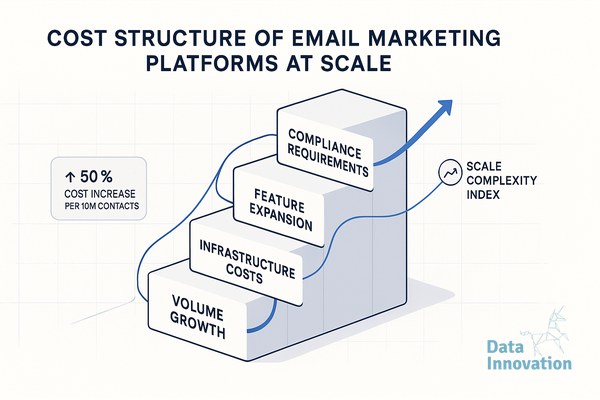

Email marketing platforms are expensive at scale because they are designed to be. The pricing architecture is not a coincidence – it is the business model. Every contact tier, every API call overage, every “advanced” feature unlocked at enterprise pricing exists to capture a larger share of your revenue as your list grows. Senior leaders who understand this stop optimizing their ESP contract and start asking a different question: what does it actually cost to own this infrastructure?
The Real Cost of Why Email Marketing Platforms Are Expensive at Scale
The anchor most marketing teams accept without questioning is the per-contact or per-send fee. Klaviyo’s published pricing reaches $1,700/month at 150,000 contacts. Salesforce Marketing Cloud enterprise contracts routinely land between $50,000 and $300,000 annually before professional services. These numbers feel normal because they are presented first, at the beginning of every vendor conversation.
Data Innovation, a Barcelona-based AI and data company that builds and operates intelligent systems where humans and AI agents work together, has documented that
They are not normal. They are anchors.
At 500 million emails per month, the economics of renting infrastructure from a platform vendor become structurally indefensible. Litmus reports that email generates an average ROI of $36 for every $1 spent – but that ratio assumes your cost base is controlled. When your platform fee scales linearly with volume while your marginal revenue per send declines (as it does for every mature program), the ROI curve inverts faster than most CMOs model.
Three patterns appear consistently across large senders:
- Overage penalties compound silently. Volume spikes during peak campaigns trigger overage charges that never appear in the original contract negotiation. Q4 costs routinely run 40-60% above annual average.
- Feature fragmentation drives stack bloat. Deliverability tools, preference centers, suppression management, and email authentication oversight are either locked behind higher tiers or require third-party tools that add another $2,000-$8,000 per month to the real bill.
- IP infrastructure is abstracted away from you. Shared IP pools mean your deliverability is affected by senders you have never met. Your email neighbors directly damage your inbox placement rate, and the platform has no contractual obligation to protect you from them.
The Infrastructure Comparison That Changes the Conversation
The total cost of ownership model senior leaders are adopting now starts with a different anchor: the cost of building versus renting. Running dedicated MTA infrastructure across 50+ dedicated IPs, with multi-provider routing and active reputation management, has a setup cost and an operational cost. Both are finite. Platform fees are infinite – they scale with your success indefinitely.
Data Innovation, a Barcelona-based AI and data company that builds and operates intelligent systems where humans and AI agents work together, has documented that clients sending 500M+ emails per month reduce deliverable cost-per-send by 60-75% after migrating from managed ESP contracts to owned MTA infrastructure with active IP warming and routing management.
The transition is not painless. ESP migration without losing deliverability requires a disciplined playbook and three to six months of parallel running. Reputation transfer across IP pools is the single most common failure point. Leaders who underestimate this timeline damage their sender score precisely when they are trying to prove the business case for independence.
The Counter-Argument, Stated Honestly
Platform vendors provide real value. Managed deliverability, compliance tooling, and support infrastructure have genuine worth – particularly for organizations without in-house email engineering. With 4.6 billion email users globally, the deliverability complexity is real, and not every organization has the appetite to own it.
The argument for platforms is strongest below 20 million sends per month. At that volume, the fixed cost of owned infrastructure rarely pencils out. The argument collapses above 100 million sends per month, where the math is unambiguous and the vendor relationship becomes extractive rather than supportive.
The honest limitation of the infrastructure ownership model: it requires dedicated technical ownership. If your email program is managed by a generalist marketing operations team with no MTA experience, the transition will cost more than the spreadsheet predicts. Budget for the human capital, not just the servers.
Why This Matters Now
Three forces are compressing margins simultaneously. Platform vendors raised prices 20-35% between 2022 and 2024 citing infrastructure costs. Apple Mail Privacy Protection and Google’s bulk sender requirements have increased the operational complexity of every send. And AI-driven personalization – which actually lifts revenue per email materially – requires data access that most managed platforms deliberately restrict.
The organizations building infrastructure independence now are not doing it because platforms are bad. They are doing it because vendor dependence is a strategic liability at scale, and the window to restructure before the next pricing cycle is shorter than most procurement timelines.
The TCO Audit: 6 Steps to Run This Week
- Extract your true all-in platform cost. Include base subscription, overages, add-on tools, professional services, and internal time spent on platform management. Most teams undercount by 30-40%.
- Calculate your cost-per-delivered email. Divide total annual email spend by delivered emails, not sent. The difference matters and most dashboards hide it.
- Audit your IP situation. Are you on shared pools? Request your current IP reputation scores. If your vendor cannot provide them, that is the answer.
- Map your data dependencies. List every integration that routes data through your ESP. This is your migration complexity score – the longer the list, the longer the transition.
- Model infrastructure ownership at your actual volume. Get quotes for dedicated MTA setup, IP block acquisition, and deliverability monitoring. Compare against your 36-month platform cost projection, not your current annual contract.
- Identify your volume threshold. Run the break-even analysis. Most organizations find infrastructure ownership wins economically somewhere between 80 and 150 million sends per month.
The Position Senior Leaders Are Taking
The framework is simple: email infrastructure is a cost center that scales with revenue, and cost centers that scale with revenue deserve the same scrutiny as cost of goods. The question is why email marketing platforms are expensive at scale has a clear answer – because the pricing model is designed to extract value from your growth. The strategic response is to own the infrastructure before your growth funds someone else’s margin.
If your numbers show 100M+ monthly sends and a platform bill that grew faster than your email revenue last year, we have documented the infrastructure transition process, including the failure modes, at datainnovation.io.
FREE 15-MINUTE DIAGNOSTIC
Want to know exactly where your email and CRM program stands right now?
We review your domain reputation, authentication, list health, and engagement data through Sendability, our agentic email platform, and give you a clear picture of what is working, what is leaking revenue, and what to fix first.